A Practical Guide to Automation Email Marketing Funnels
Discover how to use automation email marketing to power interactive funnels. Learn to build workflows for quizzes and audits that boost conversions.
Forget the tired old email blasts that everyone sends straight to the bin. Real marketing success today is about creating automated, personal conversations that react to what your audience actually does. This isn't just about a simple welcome series; it's about making automation email marketing the engine behind your high-converting interactive funnels.
Why Automation Is More Than Just Sending Emails
The goal isn't just to send emails anymore. It’s about delivering the perfect message at the precise moment someone is most engaged. This one shift—from broadcasting to everyone to having a one-on-one conversation—is what drives massive improvements in lead quality and frankly, insane conversion rates.
You’re basically turning your marketing from a monologue into a dynamic dialogue. Instead of a one-size-fits-all message, you're delivering an experience tailored to the direct feedback you just received.
The Power of Zero-Party Data
We're going to dive deep into how tools like quizzes, assessments, and calculators capture incredibly valuable zero-party data. This is the goldmine of information a customer intentionally and proactively shares with you. It's the fuel for everything we're about to build.
When someone completes your quiz, they're not just another name on your list. They are literally telling you what they need, what their problems are, and where they want to go. This data allows your automated email sequences to turn that input into a genuinely helpful, relevant journey.
The big idea is simple but powerful: use what your audience tells you to give them exactly what they want. This builds trust and moves them down the funnel faster than any generic campaign ever could.
Connecting Automation to Your Funnel
This guide is all about designing and implementing a complete system. Building an effective automation email marketing strategy is a crucial piece of a much larger lead generation system that nurtures prospects from their very first click all the way to the sale. If you're looking for more foundational strategies, A Founder's Guide to Marketing Automation for Ecommerce is a solid read that breaks down key concepts for online businesses.
A well-oiled automated funnel can do some heavy lifting for you:
- Instantly Deliver Value: Fire off personalised quiz results or audit summaries the second a user hits submit. This immediately reinforces your brand's expertise.
- Nurture Leads Intelligently: Guide prospects with content that speaks directly to the challenges and interests they just told you about. No more guessing.
- Qualify Leads on Autopilot: Segment users based on their answers, so your sales team only spends time on the hottest, most promising opportunities.
At the end of the day, plugging interactive content into smart automation takes marketing from a game of guesswork to a science of conversation. It makes every email feel less like a sales pitch and more like the next helpful step in the valuable experience you just provided.
Designing Smarter Triggers and Segments
An email automation strategy is only as good as its triggers. A generic 'form submitted' trigger is a massive missed opportunity. When you use interactive tools like quizzes or calculators, that trigger suddenly becomes a goldmine of user intent and self-disclosed information.
This is where things get interesting. Instead of lumping every new lead into the same welcome sequence, you can design intelligent triggers based on specific scores, outcomes, or even individual answers. Get this right, and you're laying the foundation for an automated experience that feels deeply personal and genuinely helpful.
This is the modern flow: moving from mass communication to hyper-personalised, automated messaging.
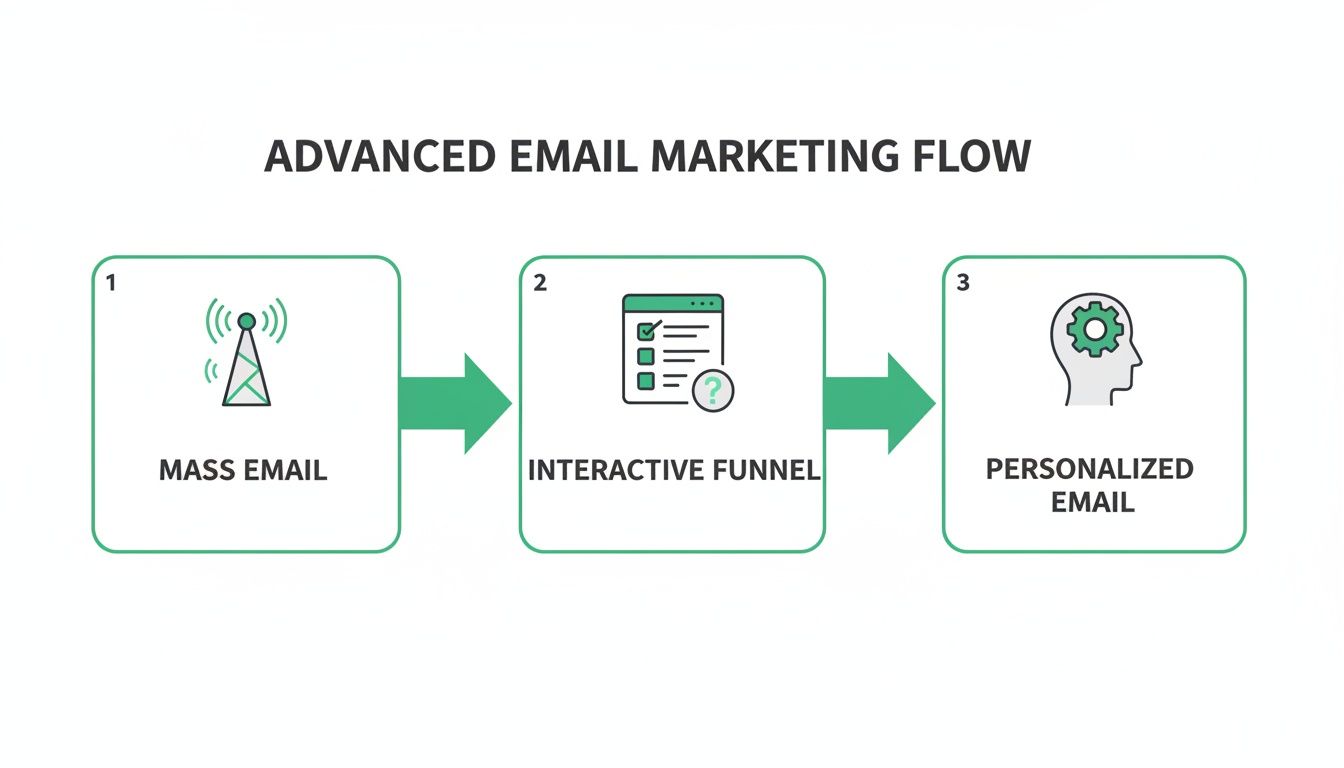
The diagram shows a critical shift. We're using interactive funnels as a bridge to translate broad outreach into what feels like a one-on-one automated conversation.
From Answers to Actionable Segments
The zero-party data you get from an interactive tool is your blueprint for segmenting leads in real-time. The trick is to map a user's answers directly to their specific pain points or goals, and then automatically tag them in your email platform.
Imagine a marketing agency that uses a "Marketing Maturity Assessment" as a lead magnet. Instead of one generic welcome email, they can create three distinct paths:
- Low Score (Beginner): A user scoring in the 'beginner' range gets tagged as 'Needs_Fundamentals'. They are immediately dropped into a nurture sequence that sends them educational content on core marketing principles.
- Medium Score (Intermediate): This user is tagged as 'Ready_To_Scale'. Their automated sequence is all about case studies and strategies for growth and optimisation.
- High Score (Advanced): Tagged as 'Expert_Level', this lead gets an email that skips the basics and offers a direct invitation to a strategy call to discuss their specific challenges.
This level of dynamic segmentation makes every single communication feel immediately relevant. Your brand comes across as genuinely helpful, not just another company blasting out emails. For a deeper dive into the mechanics, you can explore systems for lead scoring in HubSpot, which uses similar principles to categorise leads based on their data.
Using Pain Points to Drive Personalisation
You can go even deeper than just a simple score. Individual answers unlock incredible personalisation opportunities.
What if your assessment asks, "What's your single biggest marketing challenge?" with options like 'Lead Generation,' 'Brand Awareness,' or 'Customer Retention'? This is where you can create some seriously powerful automations.
Someone who picks 'Customer Retention' doesn't need five emails about top-of-funnel tactics. Their very first automated email should hit their stated problem head-on. A practical example would be a subject line like, "Three quick wins for customer retention." It speaks directly to their pain.
This is the whole point of modern automation email marketing. It's not about tricking people into converting. It's about listening to what they need and using automation to deliver the solution faster and more effectively than any human ever could.
To get even more advanced, you could look into techniques like predictive churn modeling. This can help you identify at-risk customers and create targeted re-engagement campaigns before they even think about leaving, making your segments even smarter.
Of course, all of this relies on getting good data in the first place. If your lead magnet is weak, the information feeding your automation will be weak, too. A great starting point is to analyze your current lead magnet strategy. Tools like the free lead magnet audit from Magnethive can generate a comprehensive report with AI-powered ideas to strengthen your data capture from the very beginning. This ensures your triggers and segments are built on a solid foundation of high-quality, user-provided information.
Designing Email Sequences That Actually Convert
Okay, you've nailed the trigger. Your new lead has been tagged with all that juicy, self-reported data from your quiz. Now for the million-dollar question: what do you actually send them? This is where your automation email marketing moves from a tech setup into a real conversation.
The trick is to make the whole thing feel like a seamless continuation of the quiz they just took. You're not starting a conversation from scratch; you're picking up where they left off. Here are three core sequence blueprints that have proven effective for turning a fresh lead into a sales-ready prospect—all on autopilot.
The Instant Value Sequence
Your very first email is the most important one you'll send. Period. Its only job is to deliver the personalised results from the quiz, assessment, or audit they just completed. Do this right, and you instantly prove the value you promised and build a foundation of trust.
This sequence is usually short and sweet—just one or two emails. The goal here is a quick win, not a long, drawn-out nurture campaign.
- Email 1 (Immediate): This is the payoff. Deliver their score, their "type," or a summary of their audit findings. The content here has to be dynamic, pulling in their specific data to make it feel like it was written just for them.
- Email 2 (24 hours later): Add a little more context or a clear "next step" resource related to their results. For instance, if their result was "Beginner," this email could point them to a foundational guide or a quick video tutorial.
Think of the Instant Value Sequence as your digital handshake. A firm, confident handshake proves giving you their email was a smart move. A weak one, and you’ve lost them before you even get started.
Your subject lines here are absolutely critical. They need to be crystal clear and grab attention. Practical examples include:
- "Your [Quiz Name] Results Are In!"
- "Here's Your Personalised [Assessment] Report"
- "[First Name], Your Marketing Score is..."
For the call-to-action (CTA), avoid a hard sell. Instead, get them to engage more deeply with their own results. Something like "View Your Full Report" or "Explore Your Results Dashboard" works perfectly.
The Problem-Agitation Sequence
Once you've delivered that initial hit of value, it’s time to put that zero-party data to work. The Problem-Agitation Sequence uses their self-identified challenges to gently shine a light on the pain points they’re dealing with. This isn't about scaring them; it's about positioning your product or service as the obvious, helpful solution.
This sequence is all about empathy. You're showing them you genuinely understand their struggles because they literally just told you about them.
Let's say a user's quiz results show they're struggling with "Time Management." The sequence could play out like this:
- Email 1: The Common Struggle. Start by acknowledging the challenge. A subject line like, "That feeling of not enough hours in the day?" connects immediately. The email copy can talk about the common frustrations of poor time management, validating what they're feeling.
- Email 2: The Hidden Cost. Now, agitate the problem just a bit by exploring the knock-on effects. Subject: "What is wasted time really costing you?" Here, you could touch on missed opportunities, project delays, or team burnout.
- Email 3: The Path Forward. Time to introduce your solution. Subject: "A new way to manage your team's time." This is where you elegantly connect their specific problem to your specific solution, framing it as the answer to the pain you've just discussed.
The framework is simple: relate, agitate, solve. It's incredibly powerful because it’s built entirely on the information they gave you, which makes your solution feel like a helping hand, not a sales pitch.
The Educational Nurture Sequence
Not every lead is ready to buy right away. The Educational Nurture Sequence is your long game. It’s designed to build trust over time by consistently delivering value that speaks directly to their interests. This is a must-have for any serious automation email marketing strategy.
This sequence is less about a specific problem and more about cementing your authority and staying top-of-mind. It’s perfect for leads who might be lower-intent or who completed a more top-of-funnel quiz.
The structure is flexible, but it should always be value-first:
- Focus on one topic per email: If their quiz showed an interest in "SEO," send one email about on-page best practices, another about link building, and a third about technical SEO. Don't try to cram everything into one email.
- Vary your content formats: Keep things interesting. Mix it up with links to blog posts, short video tutorials, insightful case studies, or invitations to webinars.
- Keep the CTA soft: The goal is engagement, not a sale. CTAs like "Read the full guide" or "Watch the 3-minute video" are perfect for this.
By consistently showing up in their inbox with helpful, relevant information—without asking for anything in return—you become their go-to resource. Then, when they are ready to make a buying decision, you'll be the first name that pops into their head.
Integrating Your Tools and Protecting Deliverability
A brilliant automation strategy is worthless if your tech doesn't talk to each other or your emails land in spam. This is where the rubber meets the road—the practical, technical side of automation email marketing. We need to make sure the data from your quiz flows smoothly into your email platform, and that every single message you send actually reaches the inbox.
Getting this foundation right isn't just a "nice-to-have." It's everything.
A seamless link between your quiz tool and your email service provider (ESP) is the central nervous system of your funnel. Without it, you're stuck manually exporting CSV files, which completely defeats the purpose of automation.
100% Free Lead Magnet Audit
Our AI analyzes your website and delivers custom growth strategies in seconds.
Making the Connection Work
So, how do you get your tools talking? You've got a couple of solid options, and the right one usually depends on the software you’re already using.
Native Integrations: This is the dream scenario. Most modern quiz builders offer direct, one-click connections to big players like HubSpot, ActiveCampaign, or Mailchimp. This means you can map quiz answers directly to custom fields or tags inside your ESP without writing a single line of code. It's the easiest path by far.
Webhooks: If a native integration isn't on the table, a webhook is your next best friend. Think of it as a real-time signal. When a user completes your quiz, the tool sends a "payload" of data (their answers, score, email) to a unique URL provided by your ESP, which then triggers your automation.
Middleware (e.g., Zapier): Tools like Zapier or Make.com act as universal translators between thousands of apps. You can set up a "Zap" that says, "When someone submits my quiz, create a new contact in my email platform and add these specific tags based on their answers." It’s incredibly powerful for custom setups.
The end goal is always the same: automatically pipe that rich, zero-party data into your system to fuel those hyper-personalised sequences. This technical plumbing is a critical part of the relationship between marketing automation and CRM systems, ensuring your data stays clean and useful across your entire stack.
Safeguarding Your Sender Reputation
Now for the part everyone ignores until it’s too late: deliverability.
All the clever segmentation in the world means nothing if your emails are flagged as spam. Inbox providers like Gmail and Outlook are constantly judging you, building a "sender reputation" score for your domain based on your technical setup and sending habits.
Your sender reputation is like a credit score for your email domain. High engagement and good technical practices build it up; spam complaints and bounces tear it down. Protecting it is non-negotiable for any serious email automation strategy.
A quick review of the three technical pillars of email authentication is useful. These are non-negotiable DNS records that tell inbox providers you're a legitimate sender, not a spammer in disguise.
SPF (Sender Policy Framework): This is a public list of all the servers authorised to send email on behalf of your domain. Think of it as the guest list for your domain's email party. If a server isn't on the list, it gets bounced at the door.
DKIM (DomainKeys Identified Mail): DKIM adds a tamper-proof digital signature to your emails. This signature proves the message genuinely came from your domain and wasn't altered in transit. It’s like a wax seal on a medieval letter.
DMARC (Domain-based Message Authentication, Reporting & Conformance): DMARC is the bouncer. It tells receiving servers what to do if an email fails the SPF or DKIM checks—let it through, quarantine it in the spam folder, or reject it outright.
Setting these up is usually a one-time task that pays dividends forever. It's the technical equivalent of showing your ID, proving you are who you say you are, and it dramatically increases your chances of landing in the primary inbox where you belong.
To keep things simple, here's a checklist to run through before you launch any major automated campaign. Following these steps helps ensure your messages don't just get sent—they get seen.
Email Deliverability Checklist for Automated Campaigns
| Checklist Item | Why It Matters | Implementation Tip |
|---|---|---|
| Authenticate Your Domain | SPF, DKIM, and DMARC prove to inbox providers that your emails are legitimate, not phishing. | Most ESPs provide a step-by-step guide. You'll need to add a few TXT or CNAME records to your domain's DNS settings. |
| Warm Up Your Sending IP | Suddenly sending thousands of emails from a new domain or IP address looks suspicious to ISPs. | Start by sending to your most engaged subscribers first, then gradually increase volume over several days or weeks. |
| Monitor Your List Health | High bounce rates and low engagement hurt your sender score. | Regularly clean your list by removing inactive subscribers and use a double opt-in process to confirm interest. |
| Check Blacklist Status | If your domain or IP ends up on a blacklist, your deliverability will plummet instantly. | Use free tools like MXToolbox to periodically check if you've been blacklisted and take immediate action if you have. |
| Use a Custom Tracking Domain | Using your ESP's default tracking domain can sometimes get you flagged by association. | Set up a custom subdomain (e.g., link.yourdomain.com) for tracking clicks. Most ESPs have instructions for this. |
Getting these technical details right isn't the most glamorous part of marketing, but it's the foundation upon which all successful automation is built. A little effort here ensures all your creative work doesn't go to waste in the spam folder.
How to Measure and Optimise Your Automation Funnel
Launching your automated email funnel is a massive milestone. But it's just the starting line, not the finish. The real magic happens when you stop treating your automation like a static, "set it and forget it" machine and start seeing it as a living system you constantly measure, tweak, and improve. This is what separates the good funnels from the great ones.
Most people get this wrong. They obsess over open rates and click-through rates. While those are nice for a quick pulse check, they don't tell you if your automation is actually making you money. Honestly, they’re just vanity metrics if they aren't tied directly to revenue.
You need to shift your focus to the key performance indicators (KPIs) that track the real success of your interactive funnel and its impact on your sales pipeline.
KPIs That Actually Matter
Focus on the numbers that reveal the true health of your automated sequences. These are the data points that connect your marketing hustle directly to sales outcomes.
Email-to-Action Conversion Rate: This is the big one. What percentage of people who get an email from a specific sequence actually do the thing you want them to do? That could be booking a demo, starting a trial, or making a purchase. This metric tells you point-blank how persuasive your emails are.
Pipeline Velocity: How fast are leads from your interactive tool moving through your sales process after your emails have warmed them up? If these leads are closing faster than your other ones, that's a massive win. It’s clear proof your automation is qualifying and educating them effectively.
Lead-to-MQL Conversion Rate: Of all the leads dropping into a nurture sequence, how many eventually hit the mark to be considered a Marketing Qualified Lead (MQL)? This tells you how well your content is actually warming up cold prospects.
Overall ROI: At the end of the day, this is what it’s all about. Calculate the total revenue you've generated from leads who went through your funnel versus what it cost you to build and run it. A positive ROI is the ultimate proof that your efforts are productive.
Tracking these outcome-focused metrics gives you a much clearer picture of what’s working and what isn't. It lets you make decisions based on data, not just gut feelings.
A Practical A/B Testing Framework
Optimisation is all about testing. A/B testing, or split testing, is just a simple way to improve your automated sequences. You pit one version of an email (A) against a slightly different version (B) to see which one performs better.
The golden rule of A/B testing is to change only one thing at a time. If you change both the subject line and the call-to-action, you’ll have no idea which change actually made the difference.
Start with your highest-impact emails—think the first email in your Instant Value Sequence or the final one in your Problem-Agitation Sequence. These are a few high-impact variables you can start testing right away:
- Subject Lines: Test a straightforward, benefit-driven subject line ("Your Custom Report is Ready") against one that sparks more curiosity ("Did we get this right, [First Name]?").
- Call-to-Action (CTA): See how different CTA button copy performs. Does "Book a Free Demo" get more clicks than "See a Live Walkthrough"? Only one way to find out.
- Email Copy Length: Try a short, punchy email against a more detailed, long-form version. Some audiences want the quick summary; others want all the nitty-gritty details upfront.
- Use of Personalisation: Does adding the user's company name or a specific pain point they mentioned in your quiz actually boost click-through rates? Test it. Don't assume.
Run each test until you have a statistically significant result—you're usually looking for at least 100 conversions per version. Once you have a clear winner, roll it out to 100% of your audience and move on to the next test.
Remember, continuous, iterative testing is the engine that drives a high-performing automation funnel.
Got Questions? Let's Get Them Answered.
You've got the blueprint, but a few questions always pop up when you're in the trenches building this stuff. Let's tackle the big ones so you can move forward with confidence.
What's the Best Software for All This Automation?
Everyone asks this, and the honest answer is: there isn't one "best" tool. It really boils down to your budget, your team's tech-savviness, and what you're already using.
That said, for the kind of logic-heavy workflows we're talking about, you need a platform that's a beast at automation and integrations.
If you're building complex, multi-path journeys based on quiz answers or assessment scores, you'll want to look at tools like ActiveCampaign, HubSpot, or Marketo. They are built for creating intricate 'if-this-then-that' rules based on tags and custom fields. This is their bread and butter.
But if you're just getting started and want something powerful without the enterprise-level complexity, platforms like MailerLite or ConvertKit have surprisingly robust automation features that are much quicker to learn.
Here's the real secret: the brand name on the box matters less than the quality of its API and integration options. Your email platform has to play nice with your interactive tool, whether that's through a native connection, webhooks, or a middleman like Zapier.
The "best" software is the one that lets you build the data-driven sequences you've designed without giving you a technical migraine every other week.
How Many Emails Should I Actually Send in a Nurture Sequence?
This number changes depending on your sales cycle, but for most B2B scenarios, a sequence of 4 to 7 emails over two to four weeks is the sweet spot. It's just enough to stay top of mind and build momentum without completely flooding their inbox.
The first couple of emails should be pure value. No pitching. Just expand on the insights they got from your interactive tool. You're building trust and showing them you're the expert.
Here's a simple breakdown that works wonders:
- Emails 1-2: Dive deeper into their results. Give them context and immediate, actionable advice. Pure value.
- Emails 3-4: Start talking about the common problems and challenges related to their results. Agitate the pain a little.
- Emails 5-7: Now you can bring in the proof. Share case studies, handle common objections, and finally, introduce your solution as the obvious next step.
The key is to watch your engagement like a hawk. If your open and click rates plummet after email #3, your sequence is either too long, or your content just isn't resonating. Use your analytics to find that drop-off point, and that's where you transition them to your main newsletter or hand them off to sales.
How Do I Personalise Emails Without Sounding Like a Creep?
This is a big one. Good personalisation makes someone feel understood; bad personalisation feels like surveillance. The trick is to be relevant and helpful, not just parrot back the data you collected.
Whatever you do, don't start an email with something like, "Because you answered 'Lead Quality' on our quiz..." It's an immediate turn-off and puts people on the defensive.
Instead, let that data point shape the entire message without ever mentioning how you got it. This is called implicit personalisation.
- What to avoid (explicit): "Since you told us your biggest challenge is lead quality..."
- What to do (implicit): The subject line is simply, "A proven framework for improving lead quality."
The body of the email then speaks directly to that specific pain point, offering insights and solutions that feel almost mind-readingly relevant. The reader doesn't feel tracked; they feel seen.
It’s the difference between a helpful conversation and just proving you have their data. Get this right, and you build a massive amount of trust. You’re not just a marketer; you’re the expert who just gets it.