B2B Lead Generation: Master b2b lead generation to Grow Your Pipeline
Boost revenue with proven b2b lead generation tactics to attract top prospects and build a scalable sales pipeline.
B2B Lead Generation is about more than just gathering names—it’s the art of drawing in other companies and turning them into real opportunities. You do this by crafting thoughtful marketing and sales moves, building trust with complex organisations, and steadily filling your funnel with prospects who fit your ideal profile.
Understanding B2B Lead Generation
At its core, B2B lead generation lives at the top of your sales funnel, setting the pace for revenue growth. Think of it as the handshake between marketing’s creativity and sales’ precision: marketing spots the right decision-makers, and sales guides them forward with timely, relevant touches.
There are three main routes you can take, each matching a different buyer stage, budget range and goal:
- Inbound Marketing draws people in with helpful content, SEO and social channels
- Outbound Outreach reaches out directly via cold emails, calls and targeted ads
- Account-Based Marketing zeroes in on specific companies with bespoke campaigns
Knowing when to lean on each approach helps you budget wisely and forecast how quickly leads will convert.
Quick Overview Of B2B Lead Generation Methods
Below is a snapshot that lays out the features, ideal scenarios and standout perks of each method:
| Method | Examples | Ideal Use Case | Key Benefit |
|---|---|---|---|
| Inbound | Blog posts, eBooks, webinars | Modest budgets; broad audience reach | Sustainable organic growth |
| Outbound | Cold emails, calls, LinkedIn | Existing contact lists; tight timelines | Rapid lead acquisition |
| Account Based Marketing | Personalised landing pages | High-value targets; complex buying cycles | Higher conversion on key accounts |
Each tactic has its moment. If you’re planting seeds for long-term authority, inbound lays a strong foundation. When quotas loom and speed matters, outbound outreach can jump-start your pipeline. And for those big-ticket deals, account-based campaigns provide the laser focus you need.
Choosing The Right Approach
When resources are limited and brand awareness is the goal, inbound marketing offers steady, scalable reach. On the other hand, if you already manage a healthy contact list, outbound outreach can quickly feed qualified leads into your CRM.
But for organisations chasing a handful of high-stakes opportunities, account-based marketing truly shines. Imagine warming up a cold account with a personalised email series and custom landing pages—that level of relevance fuels engagement and moves deals forward faster.
Account based marketing aligns teams to target high-value accounts with precision and personalised experiences.
That kind of clarity builds a predictable pipeline and lets you measure success at every step. Check out our guide on market segmentation for B2B to sharpen your targeting and connect with the right contacts at exactly the right time. For a quick audit of your current lead magnet plus fresh, AI-powered insights, give our free tool Magnethive a spin—you’ll see projected ROI in seconds.
By familiarising yourself with these approaches, you’ll be ready to pick the strategy—or blend of strategies—that lets your lead generation engine scale predictably.
Mastering Core B2B Lead Generation Concepts
Buyer personas are like a GPS for your outreach efforts. They pinpoint where prospects sit, what keeps them up at night and the language that truly moves them. With that roadmap, every email, blog post or social update feels one step closer to the buyer.
When you mould content to those carefully sketched personas, you rise above industry clatter. Suddenly, your voice echoes the buyer’s own questions and aspirations.
Buyer Personas As Strategic Maps
Imagine a biotech firm writing for lab directors. A precise persona sketch lays out daily pain points, top priorities and favoured communication channels.
Buyer personas align your team with buyer priorities, reducing wasted touches.
Key fields for each persona include:
- Demographics: Company size, sector and market position.
- Challenges: Urgent issues the buyer must solve.
- Goals: What success looks like in their eyes.
- Communication Channels: Where they engage most — email, LinkedIn, trade forums.
Everyone on your team reads from the same playbook. Sales draws from it for personalised outreach, while marketing shapes blog topics or webinars around it.
In many markets, focusing on SMEs delivers outsized results, as small and medium-sized enterprises typically make up the majority of businesses and play a key role in job creation. Learn more about this finding in the full study on B2B lead generation in Germany
By drilling into these persona details, your campaigns gain laser focus. Fewer resources slip between the cracks and engagement climbs steadily.
Multi-Stage Funnel As A Prospect Journey
Think of your funnel more like a guided tour than a single gate. Each stage warms prospects gradually and weeds out unqualified leads.
- Top-Of-Funnel Awareness kicks off with blog posts, social updates or gated ebooks.
- Middle-Of-Funnel Engagement builds trust through webinars, case studies or interactive quizzes.
- Bottom-Of-Funnel Conversion seals the deal with demos, free trials or tailored proposals.
This phased approach ensures prospects see the right content at just the right moment.
Adopting a stage-by-stage funnel is like guiding a guest through a curated museum tour, each stop revealing more context.
A SaaS startup might attract remote-work hunters with SEO-focused articles, then run a live workshop on best practices and finally invite attendees to test the product free for 14 days.
Here’s an infographic that visualises how inbound, outbound and ABM methods centre around each stage of the funnel.
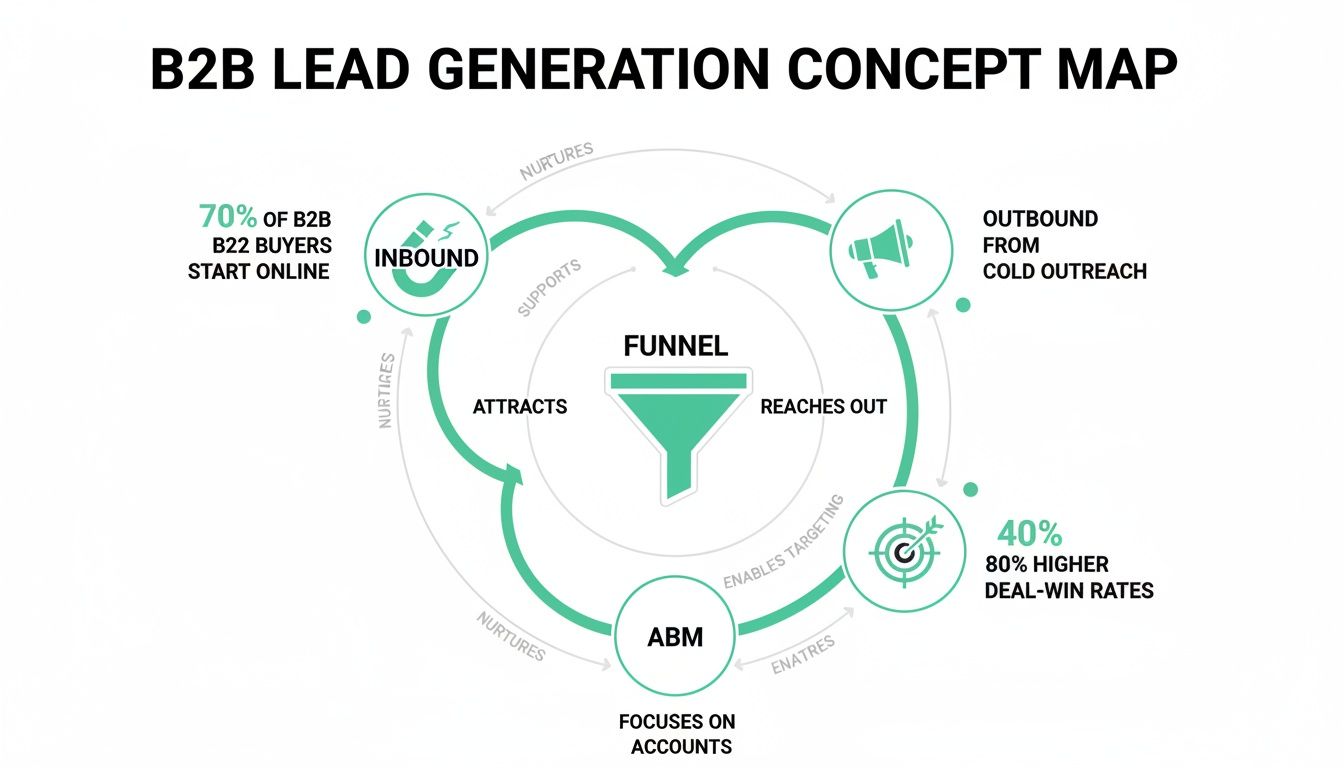
The concept map highlights that inbound tactics draw prospects into the funnel, outbound outreach strengthens mid-funnel engagement and ABM zeroes in on high-value accounts at the conversion stage.
Lead Scoring And Nurturing Frameworks
Lead scoring works like a traffic-light system, showing when a contact is ready to move forward or needs more nurturing.
- Email Open: +10 points
- Webinar Attendance: +25 points
- Pricing Page Visit: +40 points
- Demo Request: +30 points
A lead under 50 points stays in drip campaigns. Between 51 and 75 points? Time for tailored demos and direct outreach. Hit 76 points or above, and you pass the baton to sales without hesitation.
This model strips away guesswork. You know exactly when a prospect’s interest is high enough to justify a call or a personal pitch.
A clear scoring system ensures no hot lead slips through the cracks.
As you gather data, refine your thresholds. For example, you might learn that a second pricing-page view predicts purchase intent better than a webinar sign-up.
Check out our guide on B2B lead magnets to explore high-impact offerings that captivate prospects.
By mastering these core concepts, your B2B lead-generation engine becomes both predictable and scalable. Each framework fuels a steady pipeline of qualified opportunities.
Comparing Traditional And Modern Lead Generation Methods
Traditional outreach still carries weight because it’s rooted in human interaction. Cold calling, direct mail and trade shows cast a wide net—sometimes landing major accounts through sheer presence. In contrast, modern methods act like a tactical survey, homing in on the exact contacts you need with speed and clarity.
Here’s a side-by-side look at classic outreach versus digital and interactive approaches:
Traditional Versus Modern Lead Generation Methods
| Approach | Examples | Pros | Cons |
|---|---|---|---|
| Cold Calling | Phone calls to prospects | Fast meeting setups | Time-intensive research |
| Direct Mail | Personalised letters or packages | Memorable physical touch | Higher production costs |
| Trade Shows | Industry events and booths | Live demos and networking | Travel and booth fees |
| Content Marketing | Blogs, webinars, eBooks | Sustainable organic growth | Authority takes time |
| SEO Optimisation | Keyword-driven pages | Better search visibility | Needs ongoing maintenance |
| AI Chatbots | Automated site conversations | Instant engagement | Constrained by script design |
This table lays out the main advantages and drawbacks of each method, helping you pick what fits your goals and resources.
Traditional Outreach Tactics
Cold calling remains a frontline tool for sparking dialogue with gatekeepers and decision-makers. It can land appointments in days—but it hinges on solid research and well-crafted scripts.
Direct mail brings creativity back into the mix. A thoughtfully designed letter or gift can cut through the inbox clutter and linger on someone’s desk.
“A well-timed direct mail piece stands out in an age of endless emails.”
Trade shows gather your audience under one roof, fusing demos with face-to-face rapport. They excel for complex solutions but do demand significant travel and exhibition budgets.
Digital And Interactive Approaches
Content marketing draws in prospects by answering questions and solving problems. Webinars, eBooks and blog posts build trust over time.
SEO optimisation ensures those resources rank where buyers are searching. It turns your evergreen pages into a magnet for inbound leads.
AI-driven chatbots engage visitors instantly, using scripted flows that mirror a salesperson’s discovery call. They qualify interest around the clock.
- Content Marketing educates and nurtures, guiding readers toward a solution.
- SEO Optimisation anchors you in search results, boosting relevance for key terms.
- AI Chatbots speed up initial outreach and surface high-intent prospects.
Classic tactics win on familiarity and breadth. Digital approaches often excel in cost efficiency and targeting. Combine both, though, and you expand volume and improve lead quality.
Choosing The Right Mix
Your ideal blend depends on budget, headcount and growth targets. Small teams might favour SEO and chatbots to maximise limited resources. Larger organisations often pair booth space with digital campaigns to cover all bases.
Assess Your Budget
Tally up event fees, creative production and ad spend.Define Speed Goals
Decide if you need instant calls or a steady flow from content.Test And Iterate
Pilot small-scale campaigns on each tactic and scale what works.
Think of trade shows as anchors that lend credibility, with digital tools acting as accelerators for sustained momentum.
Real World Campaign Snapshots
A mid-sized SaaS firm combined a regional trade show with a three-month SEO drive. They walked away with 200+ qualified leads on the floor and saw organic traffic climb by 35%.
Meanwhile, a boutique consultancy mailed personalised boxes and activated a site chatbot. They achieved a 75% response rate on direct mail and cut lead qualification time by 50%.
These stories show how cost, speed and precision shift depending on the tactics you choose.
Comparing Cost Speed And Precision
Traditional methods often carry higher per-lead costs yet deliver rapid contact. Digital campaigns usually have lower entry costs but need time to pick up steam.
- Speed: Cold calls can yield meetings within days; SEO results emerge over weeks.
- Cost: Direct mail might run £5–£10 per piece; chatbots incur minimal incremental fees.
- Precision: ABM targets specific accounts; trade shows cast a wider net.
Use these benchmarks to fine-tune your mix. Start small, track cost per lead, conversion time and lead quality, then adjust based on real-time data. That’s how you build a robust B2B lead generation engine.
Building Your Lead Generation Strategy
Crafting a B2B lead generation plan feels a bit like piecing together a puzzle. You start by setting clear objectives, then zero in on your ideal audience and sprinkle in creative touches that resonate with decision-makers.
It’s all about balancing quick wins with long-term growth. Define measurable goals, map out your top segments and pick channels that genuinely move the needle.
For instance, a mid-sized SaaS company followed these steps and lifted demo requests by 25% in just eight weeks. That real-world result proves methodical planning really pays off.
- Establish precise objectives at each stage of the funnel
- Identify buyer personas and segments that align with your solution
- Choose channels that maximise both reach and return on investment
- Develop lead magnets that showcase your unique value
- Plan nurture touchpoints triggered by specific prospect actions
- Set up dashboards with real-time metrics to track performance
Define Clear Goals
Goals are your compass. Without them, campaigns can wander aimlessly. Maybe you’re aiming to boost qualified leads by 30% or rack up 50 new demo requests each month.
Here’s a simple framework:
- Set Specific outcomes and attach clear metrics
- Align those Metrics with a timeframe—like 90 days
- Track Progress through weekly or monthly check-ins
One agency applied this approach to webinars and saw a 120% lift in just six weeks.
100% Free Lead Magnet Audit
Our AI analyzes your website and delivers custom growth strategies in seconds.
Identify High Value Segments
Think of segmentation as sorting seeds by soil type. Each buyer group has its own needs, challenges and preferred channels.
Dive into your CRM data to rank segments by past deal size and engagement. Prioritise the groups that combine budget, authority and an urgent problem you solve.
Effective segmentation ensures your messages land where they matter most.
Select Channels And Craft Messaging
Choosing channels is like picking tools for a DIY project. Email nurtures relationships, LinkedIn outreach targets key accounts and interactive audits demonstrate ROI on the spot.
| Channel | Best Use Case | Key Benefit |
|---|---|---|
| Nurture sequences | Personalised outreach | |
| LinkedIn Ads | Targeted account engagement | Focused lead gen |
| Interactive Audit | Lead magnet evaluation | Instant ROI insights |
Then, turn features into benefits with storytelling. Start with a line like, “Imagine cutting costs by 15% in just 30 days,” and back it up with case studies or stats.
Begin with small pilot budgets on each channel, measure results and reallocate funds to the tactics driving the highest-quality leads. Execution lives in your CRM: a PDF download triggers a three-step email journey plus an invitation to book a call. Monitor open rates, click-throughs and reply times weekly to refine copy and timing.
Learn more about setting up a robust lead generation system in our detailed guide on Interactive LeadGen’s blog (Lead Generation System): https://interactiveleadgen.com/blog/lead-generation-system
Keep your engine humming with a regular review cycle. Use real data to decide when to experiment with new channels or double down on top performers. With this framework, your B2B lead generation scales predictably.
Finally, break down silos between marketing and sales. Shared dashboards and weekly syncs flag issues before they snowball. Document every campaign outcome, swap insights across teams and iterate constantly to sharpen your competitive edge.
Tracking Success With B2B Lead Generation Metrics

Numbers are the heartbeat of any B2B lead generation effort. Skip them, and you’re shooting in the dark. Track them faithfully, and you’ll catch every unexpected surge or sudden drop before it becomes a problem.
In the next few minutes, we’ll walk through five must-watch metrics that turn raw data into clear, strategic moves.
Conversion Rate And Why It Matters
At its core, conversion rate measures the percentage of visitors who actually do what you ask—download a whitepaper, sign up for a webinar or request a demo.
- Conversion Rate = (Number of Conversions ÷ Total Visitors) × 100
Imagine 500 people grabbing your ebook out of 10 000 visitors. That’s a 5 % conversion rate.
But don’t stop at the big wins. Micro-conversions—think email subscriptions or first-time clicks—offer early warnings when prospects lose interest. Spotting a trend here often means saving a campaign before it tanks.
You can boost results with A/B tests on headlines, calls to action or page layouts. Even a 15–25 % lift is enough to tilt the scales in your favour.
“Measuring conversion rates is like tuning a race car engine: minor adjustments can yield major gains.”
Cost Per Lead And Lead Quality Score
How much does each new inquiry cost you? That’s your Cost Per Lead (CPL):
- CPL = Total Campaign Spend ÷ Number Of Leads
Spend €5 000 on ads and collect 50 prospects? Your CPL is €100.
But price alone doesn’t tell the full story. That’s where your Lead Quality Score comes in. Assign points for meaningful actions:
- Email Open: +10
- Form Fill: +30
- Demo Request: +50
Calculate the average and watch it move. A rising score means you’ve nailed your targeting; a drop signals time to tweak your message or reevaluate channels.
- Low CPL might mean low-quality leads
- High CPL often delivers more engaged prospects
- Find the sweet spot between cost and calibre to meet revenue targets
Customer Lifetime Value And Overall ROI
Customer Lifetime Value (CLV) forecasts the revenue a client brings in over their relationship with you:
- CLV = (Average Purchase Value × Purchase Frequency) × Customer Lifespan
Say your average client spends €1 200 a year and sticks around for three years. Their CLV clocks in at €3 600.
Putting CLV next to CPL reveals if your campaigns pay off. Then you can calculate ROI:
- ROI = (Revenue Attributable To Campaign – Campaign Cost) ÷ Campaign Cost
When ROI tops 100 %, your programme is profitable. Use a dashboard to link every lead back to a closed deal so you’re never guessing about true returns.
Here’s a quick look at typical target ranges:
| Metric | Benchmark |
|---|---|
| Conversion Rate | 5 %–10 % |
| Cost Per Lead | 200 |
| Lead Quality Score | 30–60 |
| CLV | Context Dependent |
| ROI | > 100 % |
Building Dashboards And Spotting Trends
Dashboards bring data from every source into one place. Break it down by industry, campaign origin or buyer persona to see which efforts really move the needle.
Use:
- Line charts to follow trends over weeks or months
- Heat maps to pinpoint top-performing regions or segments
Slice your numbers weekly so a small slip doesn’t balloon into a full-blown crisis. Set alerts to ping stakeholders when metrics stray off track.
With consistent measurement, raw figures become clear actions. Whether you’re trialling a new ad headline or redesigning a landing page, these insights keep you on course.
Remember to revisit your benchmarks quarterly. Business evolves—and so should your targets.
Measurement drives smarter growth.
Consistently applied.
Avoiding Mistakes And Applying B2B Lead Generation Best Practices
A single misstep can stall your entire lead engine. In B2B, those slip-ups don’t just cost time—they erode hard-won trust. Spotting them before they snowball keeps your pipeline flowing.
For instance, overpromising is like selling a car that won’t start. Prospects feel cheated and drive away. Better to under-promise, over-deliver and let real results become your strongest testimonial.
On the flip side, neglecting timely follow-up is like ignoring a ringing phone at a busy office. A swift reply shows you’re listening—and that you care. But don’t pepper inboxes with daily pings; strike a balanced cadence that nurtures interest without feeling pushy.
Here are the classic slip-ups even seasoned teams face:
- Overpromising features your product can’t sustain.
- Ignoring feedback loops hidden in your campaign data.
- Skipping small-scale tests before a full rollout.
- Mismatching messaging between ABM and demand teams.
- Dropping the ball across channels, leaving gaps in your funnel.
These banana skins can sap momentum fast. Keep them in view to preserve a steady flow of qualified leads.
Best Practices You Need To Know
1. Automate Personalisation with dynamic fields and AI-driven templates so every outreach feels handcrafted.
2. Synchronise email, social and event calendars on a shared platform—consistency builds familiarity.
3. Align ABM and demand teams around shared goals and quick daily huddles to speak with one unified voice.
4. Pilot new tactics in small batches—think of them as lab samples—so you learn fast without risking the entire budget.
These guardrails stop you veering off course and sharpen your approach. Adopt them, and your funnel will hum along week after week.
“Small tests save big budgets and ignite continuous improvement.”
Consistent optimisation turns reactive fixes into proactive wins. A culture of testing catches issues early and fuels a predictable, healthy pipeline.
Simple checklists are your unsung hero. Use them from planning through execution to guard against oversight and keep quality high across every team.
Safeguards And Checklists
- Pre-launch review of messaging, segment criteria and scoring models
- Follow-up schedule with response windows and escalation triggers
- Data audit for feedback loops, tracking codes and attribution accuracy
- Team alignment meeting notes that capture objectives and next steps
Slot these checkpoints into your workflow to spot glitches before they snowball. A detailed checklist becomes your roadmap for every launch and keeps leads flowing.
Avoiding mistakes and embedding best practices is an ongoing journey. Each campaign teaches lessons that refine your approach—so keep tweaking and iterating.
A healthy pipeline demands attention to detail and cross-team collaboration. Regularly revisit your metrics and checklists to catch any drift before it grows.
Plan weekly or bi-weekly reviews where teams measure real results against your playbook. This rhythm drives continuous optimisation and keeps everyone aligned.
By weaving these safeguards into your routine, you’ll protect revenue streams and accelerate pipeline health. Avoidable errors will vanish, optimisation becomes second nature, and your B2B lead generation will hum with precision and predictability.
B2B Lead Generation FAQs
How Do I Choose The Most Effective Channel For My Budget?
Start by grouping your budget into clear tiers. Small teams with under $15,000 per month often see the biggest impact from:
- Content marketing (blogs, guides and case studies)
- Email nurture campaigns that build trust over time
- Targeted social ads on platforms like LinkedIn or Facebook
Mid-sized outfits can dial things up by adding webinars or showing up at trade fairs for face-to-face connections. And if you’re running a large enterprise, account-based marketing—with personalised landing pages and one-to-one outreach—becomes a powerful play.
For instance, a fledgling startup working with €3 000 a month might split its budget as follows:
- 40 % on paid social ads
- 30 % on content creation (whitepapers, infographics)
- 30 % on chatbot tools to capture and qualify visitors
That mix balances quick wins with steady pipeline growth.
How Long Until I See Meaningful Leads?
It really depends on your channel mix. SEO-driven inbound usually needs around 3–6 months before you hit a reliable trickle of leads. On the flip side, paid campaigns can start booking meetings within weeks and drive initial trial sign-ups in 30 days.
By pairing fast-acting tactics (like paid ads) with evergreen strategies (such as SEO and content), you smooth out the typical highs and lows of your pipeline.
When To Set Scoring Thresholds
Lead scoring keeps marketing and sales in sync. A simple point system might look like this:
- Email click: +10
- Whitepaper download: +20
- Webinar attendance: +30
- Demo request: +50
Set your initial hand-off at 50 points so only truly interested prospects land in the sales queue. Then, revisit those thresholds every quarter, tweaking them based on real-world conversion rates.
How Can AI Tools Streamline Modern Campaigns?
AI can sift through engagement data and suggest tailored content sequences at scale. Chatbots, for example, capture zero-party data and qualify leads around the clock.
AI-powered chatbots can increase qualification rates by offering instant, relevant answers.
Let AI handle routine tasks—data collection, basic follow-ups—so your team spends more time building relationships. This blend of automation and human touch sharpens your B2B lead generation engine without losing that crucial personal connection.
Finally, check your metrics regularly, learn from what’s working, and stay flexible. Continuous iteration is the secret sauce to long-term success.