A Guide to the Modern Lead Generation Marketing Funnel
Build a high-converting lead generation marketing funnel. Learn to map stages, use interactive content, and turn more prospects into loyal customers.
A lead generation marketing funnel isn't just some fancy marketing term. It’s a real system for turning complete strangers into qualified prospects who are actually ready to talk to your sales team.
Think of it less like a list of contacts and more like a guided journey. You're building trust and proving your value every step of the way, transforming casual website visitors into genuinely engaged, sales-ready opportunities.
Why Your Funnel Needs to Evolve Beyond Passive Content
The old marketing funnel can feel like a one-way street. You write a blog post, create an ebook, slap an email gate on it, and then just… hope. You hope they read it. You hope they see the value. You hope they eventually become a customer.
This entire model is built on passive consumption. Your prospects download your stuff and are left completely on their own to connect the dots back to your solution.
The modern, interactive funnel flips this entire script.
Instead of just broadcasting information, you create a two-way conversation. You swap out those static PDFs for interactive tools—quizzes, calculators, audits, and assessments that give people immediate, personalised value. This isn't some niche tactic anymore; it's quickly becoming the core of any serious demand generation strategy.
The market data backs this up. The European lead generation solution market is on track to hit **US 853.21 million in 2021. If you're curious about the details, you can dig into the market projection on The Insight Partners.
From Information Broadcast to Value Exchange
The real shift here is moving from shouting information at people to creating a genuine value exchange with them. A prospect doesn't just get generic advice; they input their specific situation and get a tailored analysis in return. Right then and there.
This simple change creates some massive advantages:
- You capture higher-intent leads. Anyone willing to spend a few minutes engaging with a tool is actively looking for a solution. That signals way more intent than someone mindlessly downloading yet another whitepaper.
- You gather priceless zero-party data. You learn about their goals, team size, budget, and pain points—directly from them. This is absolute gold for personalising your sales and marketing follow-up.
- You automate qualification. Based on their answers, you can automatically segment and score leads. This means your sales team only spends time talking to the people who are actually a good fit.
A well-engineered interactive funnel doesn't just give you a lead; it delivers a fully profiled opportunity. The tool basically runs the initial discovery call for you, arming your sales team with crucial context before the first conversation even happens.
For a practical example, instead of a blog post titled "5 Ways to Improve Your SEO," an agency could build an interactive "Website SEO Audit" tool. A visitor enters their URL and gets an instant report card on their site's performance. Boom. Immediate value delivered, a high-intent lead captured, and the perfect conversation starter for the agency.
Similarly, a SaaS company could ditch its ebook on calculating ROI and instead build a dynamic ROI calculator. This turns a passive reading experience into an active, engaging one that directly ties their solution to a prospect's financial goals. Building or refining your lead magnet is the first step, and you can get AI-powered ideas and a full analysis with a free tool. For a comprehensive report on your lead magnet, including ROI impact and new ideas, you can use a free tool like the Magnethive lead magnet audit.
This guide will walk you through exactly how to build this kind of interactive system from the ground up.
Let’s take a moment to see just how different these two approaches really are at each stage of the funnel. The old way puts all the work on the buyer, while the interactive model feels more like a helpful consultation.
Traditional Funnel Versus Interactive Funnel Stages
| Funnel Stage | Traditional Approach (Passive Content) | Interactive Approach (Engineered Tools) |
|---|---|---|
| Top of Funnel (TOFU) | Offers generic content like ebooks or blog posts. User passively consumes information. Goal is to capture an email. | Provides a valuable tool like a quiz or calculator. User actively engages to get a personalised result. Goal is to solve a small problem instantly. |
| Middle of Funnel (MOFU) | Sends nurturing emails with more content (webinars, case studies). Hopes the lead connects the dots to their own problem. | Delivers a detailed, personalised report based on the user's input. Follows up with content tailored to their specific pain points. |
| Bottom of Funnel (BOFU) | A sales rep reaches out with a generic pitch ("Saw you downloaded our ebook..."). They have to start the discovery process from scratch. | A sales rep reaches out with deep context ("I saw your audit results..."). The conversation starts with value, not a sales pitch. |
The difference is night and day. One feels like marketing, the other feels like help. One generates a contact; the other generates a conversation. Now, let’s get into building it.
Matching Interactive Content to Your Funnel Stages
Okay, this is where your strategy gets real. It’s one thing to talk about funnels, but it's another thing entirely to actually put the right interactive tool in front of the right person at the right time.
Let's kill the "one-size-fits-all" content mindset for good. Your goal is to create a seamless path where every single interaction offers more value than the last, pulling your prospect deeper while you gather smarter data.
This isn't just a small tweak. It's a fundamental shift from shouting at your audience (the traditional way) to starting a genuine conversation.
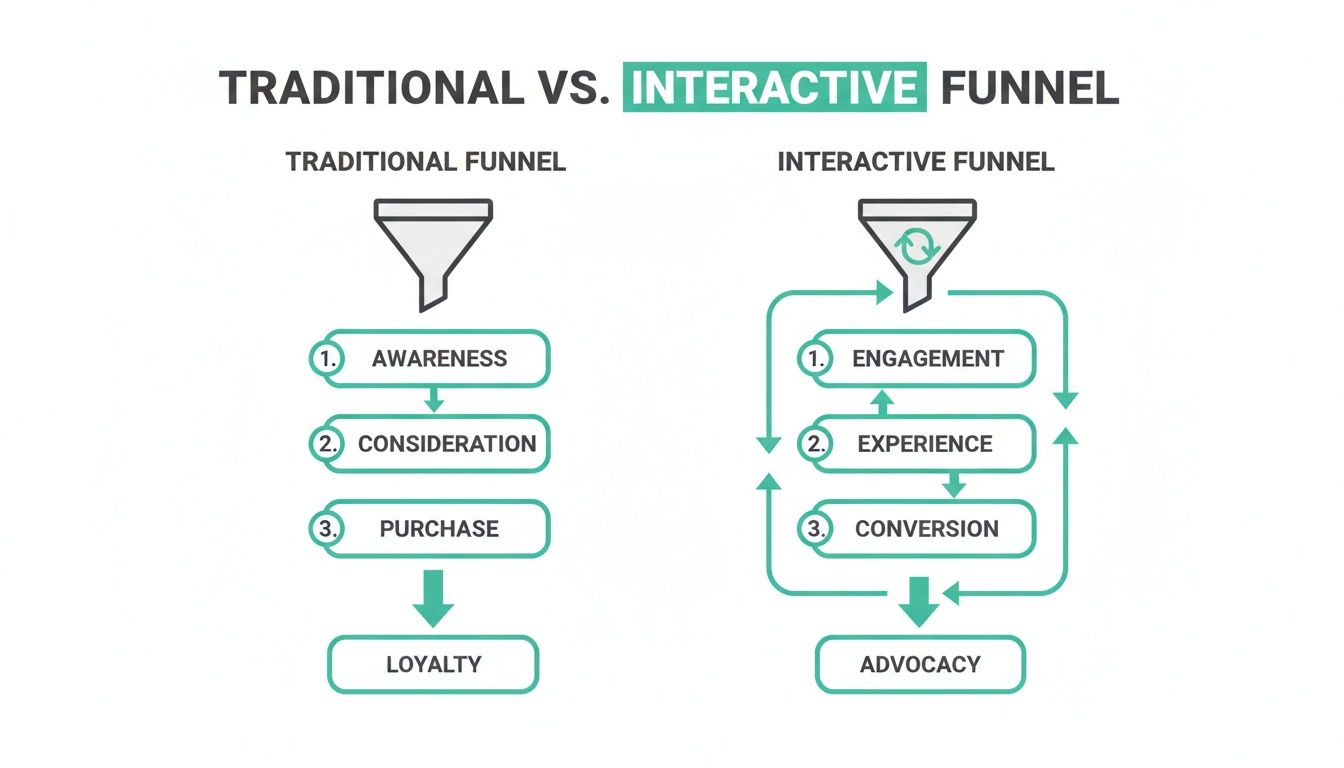
See the difference? The interactive model creates a feedback loop. Every click and answer enriches that lead's profile, making your follow-up smarter and your sales team happier.
Top-of-Funnel (TOFU): Engaging the Curious
At the very top, people know they have a problem, but they don't have a name for it yet. They're typing broad questions into Google, just trying to get their bearings. Your job here isn't to sell; it's to help them diagnose.
The goal is pure attraction and initial qualification. Offer something fast, fun, and genuinely useful—a quick win that makes them think, "Huh, these guys get me."
Here are a few practical TOFU formats that just work:
- Diagnostic Quizzes: These are perfect for helping people self-identify an issue. A marketing agency could build a "What's Your Digital Marketing Blind Spot?" quiz. It’s not pushy; it just helps a prospect realise they’ve been ignoring their SEO.
- Simple Calculators: Find one pressing question your audience has and answer it instantly. A financial advisor could offer a "Retirement Savings Calculator." It gives a clear, valuable number in seconds and immediately establishes authority.
- Website Graders: A classic for a reason. An agency can offer a "Website Performance Grader" where a visitor just plugs in their URL. They get an instant score, and you get a perfect conversation starter about how to improve it.
These tools are brilliant because they frame the problem in a way that naturally points toward your solution, all while feeling like a helpful, no-strings-attached resource.
Middle-of-Funnel (MOFU): Nurturing the Evaluators
Alright, they’re in. They’ve defined their problem and are now actively shopping for solutions. Your content has to evolve from broad education to specific, solution-focused guidance. This is where you flex your expertise.
Your goal shifts to deeper qualification and solution framing. These interactive tools are more involved. They require more from the user, but in return, they deliver personalised value that a blog post could never touch.
Effective MOFU tools look like this:
- In-Depth Assessments: A SaaS company selling project management software could offer a "Project Management Maturity Assessment." The results can segment leads based on their current chaos, allowing for ridiculously targeted follow-ups.
- ROI Calculators: A case study might tell them about ROI, but a calculator lets them plug in their own numbers to see the potential ROI for themselves. This is how you help a prospect build the business case to sell your product internally.
- Solution Recommenders: Basically a quiz that acts like a consultant. It asks about a user's specific pains and recommends the perfect product tier or service package.
The game changes at the MOFU stage. You're not just collecting an email. The answers a prospect gives you are pure zero-party data. This is marketing gold that lets you score, segment, and route leads with surgical precision, ensuring sales only talks to people who are actually a great fit.
Bottom-of-Funnel (BOFU): Converting the Decision-Makers
We’re at the goal line. Your prospects are about to pull the trigger. They’ve got a shortlist, and they're looking for that final piece of proof that you’re the right choice. Your interactive content here needs to be hyper-personalised and directly tied to closing the deal.
The goal is simple: drive conversion and sales engagement. These tools should give such a clear, customised picture of value that booking a demo becomes the obvious next step. For more inspiration, check out these killer interactive marketing examples that absolutely crush it at conversion.
Prime BOFU tools are all about personalisation:
- Product Configurators: Let prospects build their own solution. They can toggle features and see the price update in real-time. This creates a powerful sense of ownership before they’ve even bought anything.
- Proposal Generators: Why make a potential client wait for a proposal? An interactive tool can let them input their project scope and get a customised quote instantly.
- Free Audit Tools: This is the big brother to the TOFU grader. A BOFU audit is a deep, actionable analysis. A cybersecurity firm could offer a "Security Risk Audit" that spits out a detailed report, creating an immediate and urgent need for a consultation.
Designing Interactive Experiences People Actually Finish
An interactive tool can be a beast for your funnel, but only if it's actually usable. Let's be honest, we've all bailed on a clunky, confusing quiz that felt like it was designed by a committee. One wrong move and your would-be leads are gone.
The secret isn't some mystical growth hack. It's just solid user experience (UX) and conversion rate optimisation (CRO) applied to every single element, from the first headline to the final results screen.
It all kicks off with the headline. Your headline is a promise. It needs to scream "instant value." Instead of something bland like "Marketing Quiz," try "Find Your #1 Marketing Bottleneck in 60 Seconds." See the difference? One is a vague label; the other is a specific, tangible outcome with a clear time commitment.
From there, the questions themselves have to feel like a conversation, not an interrogation.
Crafting a Frictionless User Journey
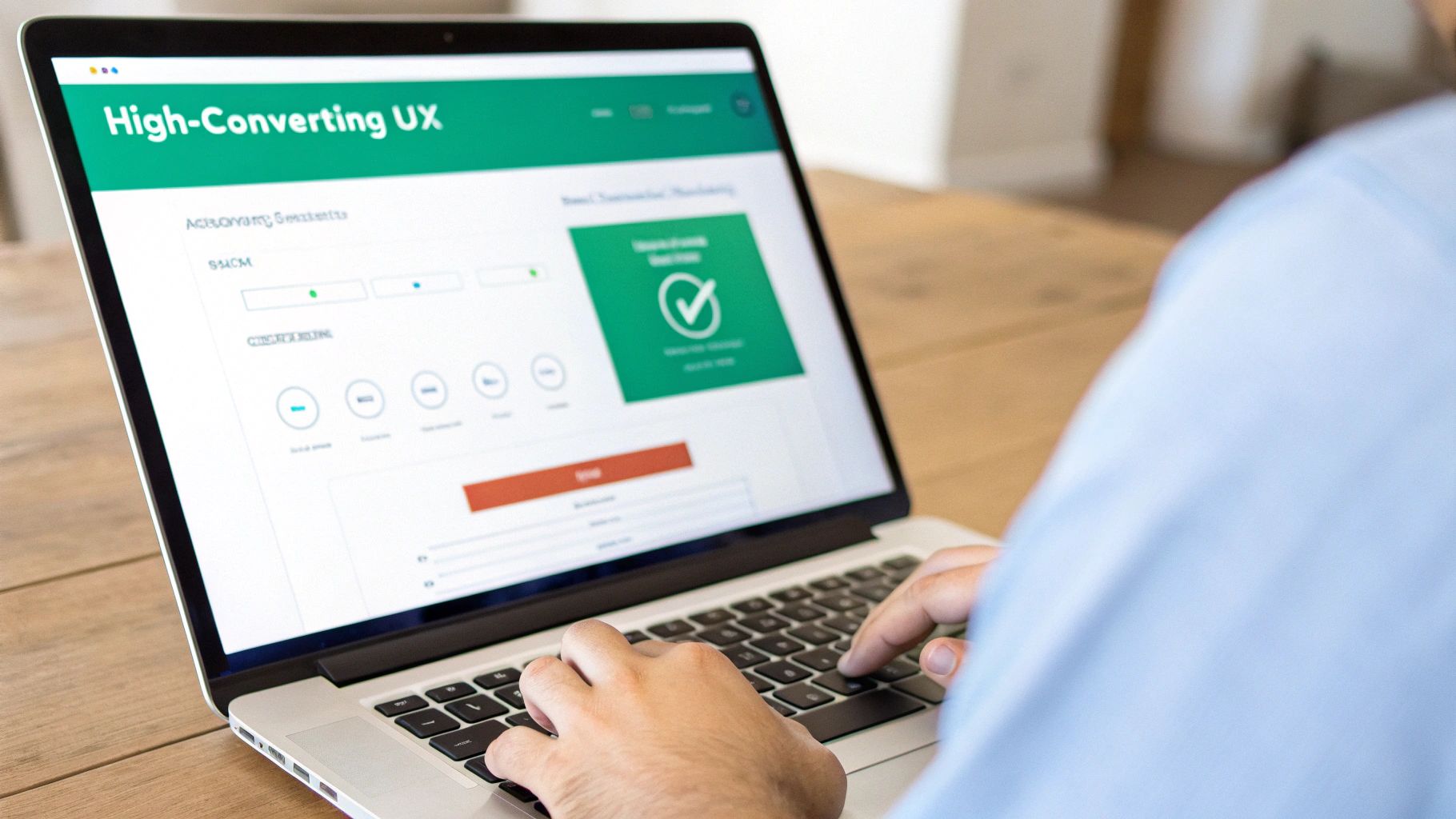
To keep people clicking from start to finish, you have to ruthlessly cut out friction. One of the easiest wins here is a simple progress bar. It manages expectations and gives people that little psychological nudge as they see themselves getting closer to the prize.
Another game-changer is logical branching. This just means you show different questions based on previous answers, making the experience feel personal. If someone using your "ROI Calculator" says they're in the SaaS industry, the next questions should be about SaaS metrics, not manufacturing. It sounds simple, but this level of relevance is what separates a generic tool from one that feels like it was built just for them.
Here are a few core principles I stick to for a smooth experience:
- One Question Per Screen: Don't dump a wall of questions on someone. It's overwhelming. One at a time keeps them focused and makes the whole thing feel much faster.
- Use Visuals and Icons: Instead of just text-based multiple-choice answers, add relevant icons or images. It breaks up the monotony and helps people process options quicker.
- Conversational Copy: Write like you talk. Use "you" and "your." Ditch the corporate jargon. Make it feel like a helpful chat with an expert, not a form-filling exercise.
These aren't massive changes, but together they create an experience that feels intuitive and genuinely helpful, which is exactly what you need to get people to the finish line. For a deeper dive, check out our guide on creating a best practice landing page to host your new tool.
Designing the Value Exchange
The moment you ask for an email is where most funnels fall apart. It's the most delicate part of the whole interaction. Ask too soon or without proving your worth, and they're gone. The data capture form has to feel like the final, logical step in a fair trade, not a gatekeeper demanding a toll.
The perfect spot for your form is right before the results page. By this point, the user has invested their time and is itching to see the payoff. You frame the ask around delivering their personalised results. Something like, "Enter your email, and we'll send your complete marketing report."
The results page is not a sales pitch. It's the fulfillment of the promise you made in your headline. It has to deliver real, insightful, and actionable information based on their answers. A weak results page will destroy all the trust you've just built.
For example, a calculator shouldn't just spit out a single number. It needs to show the breakdown, maybe benchmark it against industry averages, and offer clear, actionable next steps. This is your chance to really flex your expertise and build the trust needed to start a real sales conversation.
This principle of delivering genuine value isn't just a nice-to-have; it's critical. Ultimately, a well-designed interactive experience respects the user's time and intelligence. Do that, and you'll find they are far more likely to become the high-quality leads you're looking for.
Implementing Smart Lead Scoring and Segmentation
Getting a lead with your interactive tool is a great start. But the real magic happens next.
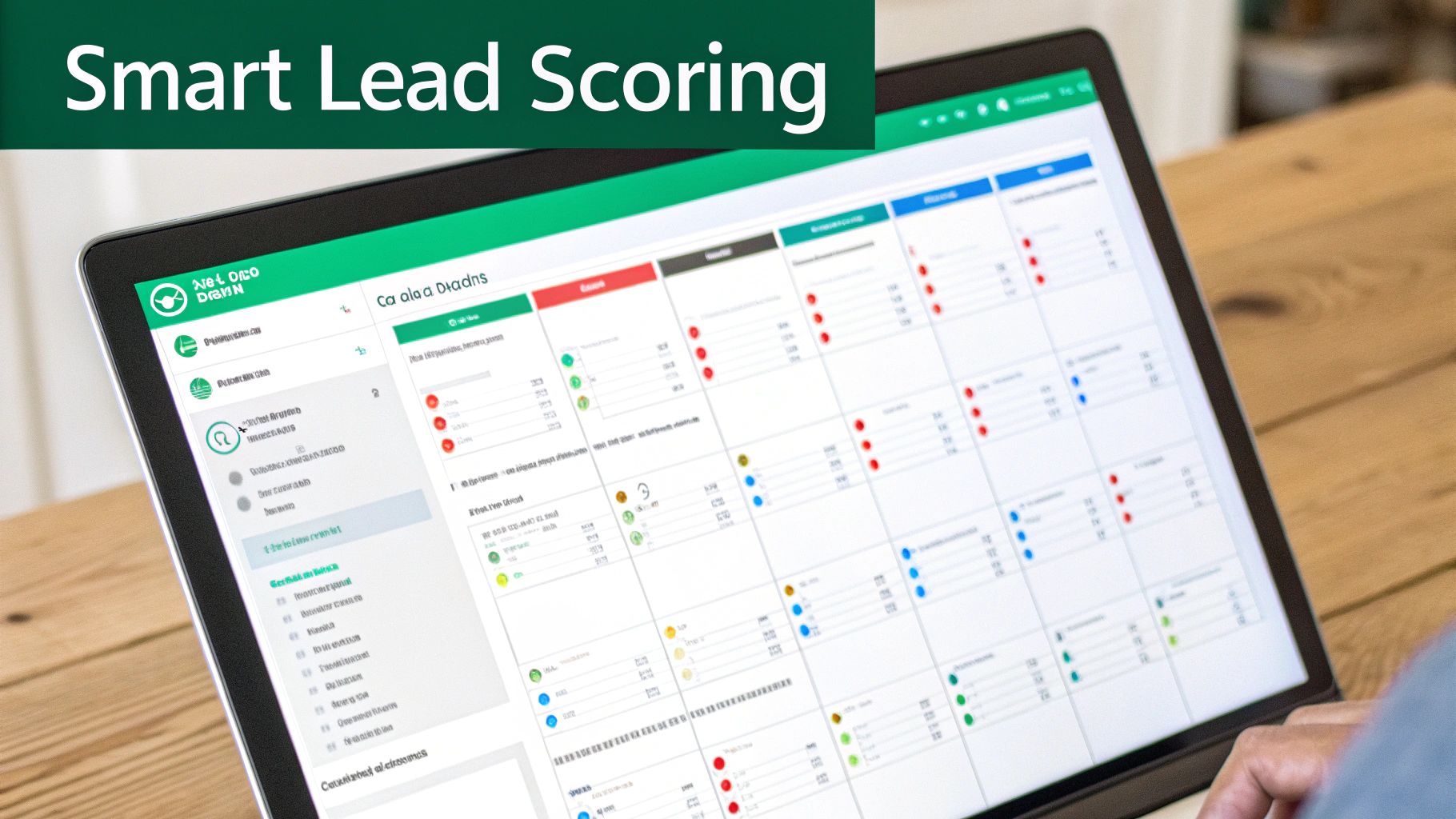
This is where you turn the raw data they’ve just handed you—that beautiful zero-party data—into an intelligent qualification engine. You’re not just collecting emails anymore; you’re building a system that understands who’s a hot prospect and who’s just window shopping, all without a single sales call.
The answers a person gives in your quiz or calculator are the keys. You can finally stop guessing based on clicks and start assigning value based on direct, explicit information they gave you themselves.
Building Your Scoring Rules from Zero-Party Data
Lead scoring with interactive content is miles ahead of traditional behavioural scoring. It’s precise. You’re creating rules based on specific answers that paint a crystal-clear picture of lead quality.
Think about it. A prospect who tells you their company has over 500 employees and a budget of more than $50,000 is in a completely different league than someone with 10 employees and a tiny budget. Your scoring system needs to reflect that reality, instantly.
Here’s a practical example of how you could set up scoring rules for a marketing assessment quiz:
Company Size:
- 1-10 Employees: +5 points
- 11-50 Employees: +10 points
- 51-250 Employees: +20 points
- 250+ Employees: +30 points
Biggest Marketing Challenge:
- "Generating more traffic": +10 points
- "Improving lead quality": +25 points (This screams "high-intent problem you can solve")
- "Measuring ROI": +15 points
Purchase Timeline:
- "Just researching": +5 points
- "Within 6 months": +15 points
- "This quarter": +30 points
These rules aren’t just pulled out of thin air; they’re tied directly to what your ideal customer looks like. Tallying up the points gives you a total score that automatically ranks every single lead that comes through the door.
A smart scoring system turns your funnel from a simple collection bucket into an automated qualification engine. It makes sure your sales team spends their valuable time only on prospects who have literally raised their hand and identified themselves as a great fit.
100% Free Lead Magnet Audit
Our AI analyzes your website and delivers custom growth strategies in seconds.
Automating Lead Routing Based on Scores
Once you have a score, the next move is to automate the handoff. This is what makes an interactive funnel so damn efficient. You can set up simple rules that send leads to different places based on their final score.
This kind of automation means every lead gets the right follow-up, instantly. No more manual triage. The whole sales cycle speeds up. If you're looking for a deep dive on how to get this running in a common platform, we've got a detailed guide on lead scoring in HubSpot.
A Tiered Routing Strategy
I’m a big fan of a tiered approach for routing. It’s all about allocating your resources where they’ll have the biggest impact. You can split your leads into distinct buckets, each with its own automated workflow.
| Lead Score Range | Tier | Automated Action |
|---|---|---|
| 75-100 Points | High-Intent (Tier 1) | Instantly create a deal in your CRM, assign it to a rep, and fire off an internal Slack alert. The prospect gets sent straight to a calendar booking page. |
| 40-74 Points | Mid-Intent (Tier 2) | Add the lead to a targeted email nurture sequence. The content should speak directly to the challenges they mentioned in the quiz. |
| 0-39 Points | Low-Intent (Tier 3) | Add the lead to your general monthly newsletter. This keeps your brand top-of-mind without burning direct sales resources. |
This automated segmentation and routing system is the operational heart of a high-performing interactive funnel. It connects the data you capture directly to real sales actions, creating a seamless process that scales beautifully as your lead volume grows.
Integrating Your Tech Stack for a Seamless Funnel
An interactive funnel is a powerful engine, but it runs on data. To really make it sing, you have to connect your interactive tools with the marketing and sales tech you already use. Without this connection, you’re just collecting answers. With it, you’re fuelling a hyper-personalised sales process.
The whole point is to create a frictionless flow of information. When someone finishes your quiz or calculator, their contact details—and more importantly, their answers—should instantly pop up in your CRM and marketing automation platform. This is the technical plumbing that makes real-time personalisation possible.
This connection turns a simple lead into a rich profile. You don't just know their name and email; you understand their biggest challenges, their budget, and their timeline because they told you themselves.
Connecting the Data Dots
Your interactive tool, CRM, and marketing automation platform need to speak the same language. This usually happens through direct integrations or a connector like Zapier. The key is making sure the data fields from your tool map correctly to the right fields in your other systems.
For example, a question in your quiz like "What is your biggest marketing challenge?" should map to a custom property in your CRM, maybe called "Primary Pain Point." This is what lets you trigger specific, relevant workflows based on their response.
The real value isn't just in passing contact information. It's about transferring the context—the 'why' behind the lead. This context allows your follow-up campaigns to be startlingly relevant, transforming a generic email into a helpful, targeted conversation.
Imagine an email nurture sequence that starts with, "I saw you identified 'improving lead quality' as your top challenge..." That's infinitely more powerful than a generic, "Thanks for downloading our guide."
Building Your Integration Checklist
To make sure the setup goes smoothly, it helps to have a checklist. Whether you’re using HubSpot, Salesforce, or something else, the core principles are the same. For a funnel that scales, integrating the right tech is everything; it’s worth exploring the best SaaS marketing automation tools to find a platform that really fits your needs.
Here's a basic checklist to guide your technical setup:
- Authentication: Securely connect your tools using API keys or OAuth. This is step one.
- Field Mapping: Carefully map every single question from your tool to a specific field in your contact records. Don't be afraid to create new custom properties to capture all that juicy zero-party data.
- Data Integrity Rules: Set up validation rules to make sure data comes through in the right format (e.g., ensuring a "Company Size" field only accepts numbers, not text).
- Trigger and Action Logic: Define what happens when a lead comes in. Does it create a new contact? Update an existing one? Create a deal in the sales pipeline? Be specific.
- Testing and Validation: Run a bunch of test submissions. Use different answers. Make sure the data is flowing correctly and your automated workflows are actually firing as you expect.
This technical groundwork is non-negotiable. A broken data flow can render your entire interactive funnel useless, leaving valuable leads and insights stranded.
Ensuring Data Compliance and Governance
As you start collecting all this detailed information, compliance becomes critical. You have to be transparent about how you're using the data and make sure your process aligns with regulations like GDPR. Your privacy policy needs to be easy to find right from your interactive tool.
On top of that, establish clear data governance rules inside your company. Decide who gets to see this sensitive information and create guidelines for how sales and marketing teams should use it.
Maintaining data integrity and respecting user privacy isn't just a legal checkbox; it's fundamental to building the trust your entire funnel relies on. A well-integrated, compliant tech stack is the final piece of the puzzle, turning your interactive tool from a standalone asset into the intelligent front door of your entire revenue operation.
Measuring Success and Optimizing for Growth
Launching your interactive funnel isn't the finish line. It’s the starting pistol.
The real work—and the real growth—kicks in after you go live. It comes from obsessively tracking what works, spotting what doesn’t, and systematically making it better. If you’re not measuring, you’re just guessing.
And let’s be clear: we need to look way beyond vanity metrics like the total number of leads. That number feels great, but it tells you nothing about lead quality or how much it’s costing you to get them. The goal is to focus on metrics that tell you the real story about the health and profitability of your funnel.
Identifying Your Core Funnel Metrics
There are a handful of key performance indicators (KPIs) that give you a true read on your funnel's success. These are the numbers that help you find friction points, figure out if you're attracting the right people, and ultimately calculate your return on investment.
Start by getting a grip on these essential data points:
- Conversion Rate Per Stage: What percentage of people move from one step to the next? Think: from starting your quiz to actually finishing it, or from seeing their results to booking that demo. This number immediately shows you exactly where people are bailing.
- Lead Quality Score: You need to be monitoring the average score of the leads coming through. If your average score is consistently low, it’s a massive red flag that your top-of-funnel content is attracting the wrong crowd.
- Cost Per Qualified Lead (CPQL): This is the ultimate efficiency metric. It’s simple: how much are you spending to generate a single lead that actually meets your criteria? This is the number your CFO cares about.
A low conversion rate between starting a tool and completing it almost always points to a UX problem. Are the questions too confusing? Is it just too damn long? Pinpointing this drop-off is your first clue for what to fix.
A Framework for Continuous Optimisation
Once you’ve got your baseline metrics, it's time to start the fun part: iterative improvement through A/B testing. The idea is to change just one thing at a time to see how it moves the needle on your conversion rates.
Focus your tests on the highest-impact areas first. For interactive tools, that means:
- Headlines: Test different ways of framing the value. Does "Calculate Your ROI" pull better than "See How Much You Could Save"? You'd be surprised.
- Question Wording: Tiny tweaks in how you ask a question can have a huge impact on completion rates. Try testing conversational language against more direct, formal phrasing.
- Calls-to-Action (CTAs): On that crucial results page, experiment with different CTAs. Does "Book a Demo" convert as well as "Schedule a Free Strategy Call"? Only testing will tell you.
Before we dive into the specific metrics, it’s crucial to remember that the effectiveness of any lead generation marketing funnel is ultimately measured by its financial return. Understanding How to Measure Marketing ROI for Real Business Growth provides the perfect framework for connecting your funnel's performance directly to bottom-line business results.
Key Funnel Performance Metrics to Track
To make this super practical, here’s a breakdown of the metrics you should have on your dashboard. These aren't just numbers; they're diagnostic tools.
| Metric | What It Measures | Industry Benchmark | Optimization Tactic |
|---|---|---|---|
| Start Rate | % of visitors who begin the interactive experience (e.g., click "Start Quiz"). | 70-85% | Test different headlines, hero images, and the initial CTA button copy/colour. |
| Completion Rate | % of starters who finish the entire experience and see the results page. | 50-70% | Shorten the quiz/tool, simplify questions, and add a progress bar to reduce friction. |
| Lead Capture Rate | % of completers who submit their contact information to get their results. | 30-60% | A/B test the lead form copy. Clarify exactly what they will get in return for their email. |
| Click-Through Rate (CTR) on Results Page | % of leads who click the final CTA (e.g., "Book a Demo") after seeing their results. | 10-25% | Personalise the CTA based on the user's results. Test button text and placement. |
| Sales Qualified Lead (SQL) Rate | % of captured leads that are deemed sales-ready based on your scoring criteria. | 15-30% | Refine your lead scoring rules. Adjust TOFU content to attract a more relevant audience. |
By tracking the right metrics and constantly testing, you transform your funnel from a static webpage into a dynamic growth engine—one that consistently delivers a pipeline of high-quality, sales-ready leads.
Got Questions? I've Got Answers
Jumping into a new strategy like this always brings up a few "what ifs" and "how tos". That's normal. Let's tackle some of the most common questions I hear from marketers building their first interactive funnel.
What’s the single biggest mistake people make?
Easy. They gate the value.
It’s tempting to slap an email form right at the beginning, but it kills the experience. Your tool has to feel like a genuine gift, not a sales trap. People came for an answer, a diagnosis, or a calculation—give it to them first.
The lead capture should feel like a fair trade for the awesome insight you just provided, not a tollbooth blocking the way. Deliver the "aha!" moment, then ask for their details. It’s a simple shift, but it changes everything.
I’m not a developer. How technical does this get?
Honestly, it depends on how ambitious you want to be.
Sure, a completely custom, ground-up calculator might need some developer time. But for 90% of marketers, that's total overkill. The market is flooded with fantastic no-code and low-code platforms built specifically for people like us.
Tools like Typeform, Outgrow, or even Tally have templates for quizzes, assessments, and calculators you can get live without touching a single line of code. The real work isn't in the coding; it's in the strategy, the questions you ask, and the value you deliver.
Okay, so how do I pick a killer topic for my first tool?
Don't overthink it. Start by listening.
What are the most common, nagging questions your prospects have long before they're ready for a sales call? What are they trying to figure out on their own? That's your goldmine.
Frame your tool around giving them an instant, personalised answer. Think diagnosis, assessment, or calculation. Good starting points often sound like:
- "How much could we actually save by switching to [Your Solution]?"
- "What's our team's biggest operational bottleneck right now?"
- "Am I paying too much for [Service You Compete With]?"
A great topic solves a real, painful problem your customer is wrestling with at the top of the funnel. Nail that, and they'll be lining up to use your tool.