A Proven Lead Magnet Funnel Template That Converts
Use our battle-tested lead magnet funnel template to turn visitors into qualified leads. Get actionable strategies for setup, automation, and optimization.

A killer lead magnet funnel template boils down to just three parts: a landing page that grabs attention, a thank you page that does more than just say thanks, and an email sequence that keeps the conversation going. The whole point is to create a valuable exchange, not just sling a generic PDF at someone and hope for the best.
This setup is designed to smoothly guide a curious visitor from their very first click all the way to becoming a lead who’s actually ready to talk business.
Your Blueprint For A Modern Lead Magnet Funnel
The days of slapping an ebook on a landing page and watching the leads roll in are long gone. If that’s still your strategy, you’re playing a game that ended years ago. Today's winning funnels are built around a modern lead magnet funnel template that puts genuine value, interaction, and smart automation front and centre.
The goal has shifted. We're not just collecting email addresses anymore. We're building a repeatable system that educates, qualifies, and nurtures prospects from the second they opt in.
If you're a bit fuzzy on the basics, getting your head around what a sales funnel is will give you some helpful context. Think of this lead magnet funnel as the perfect entry point for that bigger journey.
The Power of Interactive Exchanges
Static content is dead. Instead of another PDF destined to gather digital dust, the smartest funnels now use interactive tools like quizzes, calculators, or quick assessments. Why? Because they offer immediate, personalised value. It’s the difference between reading a book about fishing and actually catching a fish.
As a practical example, consider a marketing agency. They could offer a generic SEO guide, or they could offer a free website audit tool that spits out instant, personalised recommendations. The audit tool is far more compelling because it provides immediate, tailored value directly related to the prospect's own business.
This approach doesn't just create a better experience for your prospect. It also hands you a ton of valuable zero-party data you can use to segment your list and personalise every single follow-up.
This is what that flow actually looks like in practice. Simple, but incredibly effective when done right.
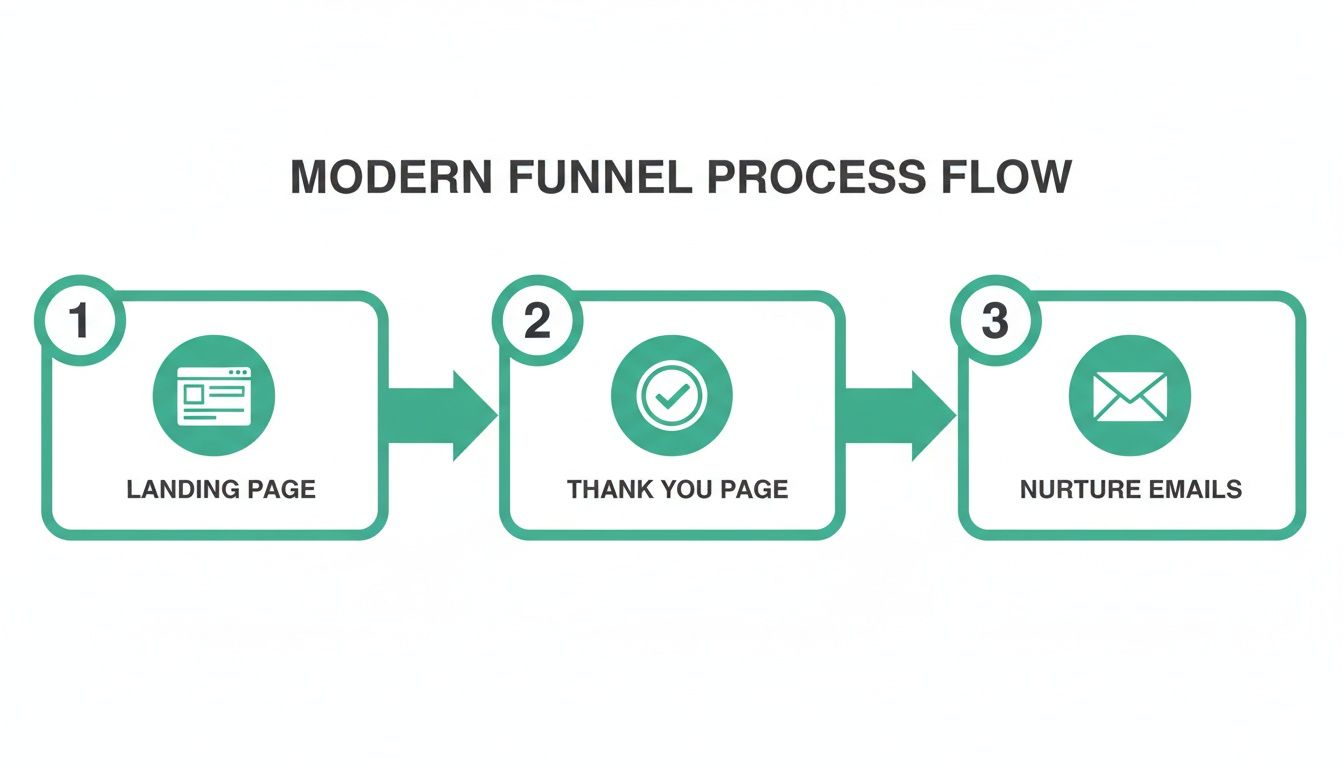
The key takeaway here is that each step is intentionally designed to build momentum. You're not just giving something away; you're guiding them to the next logical step in their journey with you.
Core Stages of a High-Converting Funnel
Every successful funnel is built on a foundation of three critical components working in harmony. Each stage is an opportunity to build trust, demonstrate your expertise, and subtly move people closer to your core offer.
Here’s a quick breakdown of the core stages and what each one is responsible for.
| Funnel Stage | Primary Goal | Key Performance Indicator (KPI) |
|---|---|---|
| Landing Page | Capture a qualified lead by offering a high-value exchange. | Landing Page Conversion Rate (%) |
| Thank You Page | Deliver the lead magnet and guide the lead to the next step. | Secondary CTA Click-Through Rate (%) |
| Email Nurture Sequence | Build a relationship, provide value, and qualify the lead for a sale. | Open Rate (%), Click-Through Rate (%) |
Think of these not as separate pages, but as a cohesive system designed to create a seamless experience for your new lead. We can now dig into what makes each one tick.
- The Landing Page: This is your front door. Its only job is to present a crystal-clear, irresistible value proposition that convinces a visitor to trade their contact info for your lead magnet. No distractions, no fluff.
- The Thank You Page: This is so much more than a confirmation message. It delivers the goods, sure, but it also sets expectations for what happens next and can even present a second call-to-action to accelerate their journey—like booking a demo or joining a community.
- The Email Nurture Sequence: This is where the real magic happens. This automated series of emails delivers ongoing value, tackles their biggest pain points, and gently guides the new lead toward your main product or service, building a real relationship over time.
Building The Core Funnel Components
A slick lead magnet funnel template isn't just theory; it's built from solid, practical pieces designed to walk someone from curiosity to conversion. Getting these core assets right—your landing page and your thank you page—is absolutely non-negotiable. They're the engine of the whole machine.
This is where we go from blueprint to build, focusing on how to strategically set up each page. The goal is a seamless, persuasive experience that feels helpful, not pushy.
Designing The Perfect Landing Page
Your landing page has one job and one job only: convince visitors to trade their contact information for your lead magnet. Every single element has to support this goal. Clutter, confusion, or a weak value proposition will send your conversion rates into a nosedive.
Think of it like a focused sales pitch. Here are the essential ingredients for a page that actually performs:
- A Crystal Clear Value Proposition: Your headline and sub-headline must instantly answer, "What's in it for me?" Don't try to be clever; be direct. For a lead magnet that is a checklist for improving website SEO, a practical headline would be, "The 10-Point Checklist to Improve Your Website's SEO in Under an Hour."
- Minimalist Design: Get rid of all distractions. That means no navigation menu, no footer with social links, and definitely no competing calls-to-action. The user should have only one path forward: click the button and get their resource.
- Persuasive Copy: Use bullet points to quickly hit on the main benefits of your lead magnet. Focus on outcomes, not features. Instead of saying "Includes a 5-page PDF," say "Learn the exact framework to solve [specific problem]."
Key Takeaway: The best landing pages are ruthlessly simple. They present an irresistible offer so clearly and concisely that opting in feels like the only logical next step for the visitor.
By keeping the design focused and the copy benefit-driven, you create an environment where conversion is the most natural outcome.
Transforming The Thank You Page
Most marketers treat the thank you page as an afterthought—a simple "Thanks for subscribing!" and that's it. This is a massive missed opportunity. A strategic thank you page is a powerhouse asset that can pull off three critical tasks at once.
It immediately delivers on your promise, sets clear expectations for what happens next, and—most importantly—it presents a secondary call-to-action (CTA) to push the user further down the rabbit hole.

Here's how to structure this page for maximum impact:
- Instant Delivery: Provide a clear, impossible-to-miss button or link to download the lead magnet. Reassure them that it's also on its way to their inbox, just in case.
- Set Expectations: Briefly tell them what's coming. For example, "Look out for an email from us tomorrow with another helpful tip on [topic]." This primes them to actually open your upcoming emails.
- Offer a Secondary CTA: This is your chance to segment your most engaged leads. Offer a logical next step, like booking a demo, joining a community, or watching a case study video. If the lead magnet was a "Website Audit Checklist," a perfect secondary CTA would be "Book a Free 15-Minute Strategy Call to Discuss Your Results."
This strategic approach turns a passive confirmation page into an active engagement tool. It capitalises on the peak excitement a new subscriber feels right after they've opted in.
Crafting effective landing pages is part art, part science. You can dive deeper into specific strategies and see more examples in our guide on best practice landing page creation.
The effectiveness of this model is backed by real-world data. We’ve seen B2B marketers using a lead magnet funnel with a high-value audit tool achieve landing page opt-in rates around 18%. This led to a 3x increase in lead quality and slashed their sales cycle from an average of 64.5 days to under 50. You can discover more insights about these B2B conversion benchmarks.
Crafting Your Automated Nurture Sequence
Getting someone to download your lead magnet is a great start. But that’s only half the battle.
The real money is made in the follow-up. Without a smart, automated email sequence, that new lead’s initial interest will disappear fast. They’ll forget who you are and why they even signed up.
This is where your nurture sequence steps in. It’s a series of automated emails designed to build a real relationship, deliver even more value, and gently guide that new contact from a curious subscriber to someone who’s ready to buy. It’s how you turn a simple email address into a genuine business asset.

The goal here isn't to blast them with sales pitches from day one. It's to prove you understand their world and have the answers they're looking for.
The Anatomy Of A Winning Nurture Sequence
A powerful nurture sequence isn’t just a random burst of emails. It’s a planned conversation that unfolds over several days, with each message doing a specific job. You can always tweak the timing, but a solid five-part sequence is a fantastic starting point for most B2B funnels.
Here’s a breakdown of an email flow that just plain works:
- Email 1: The Instant Delivery. This has to go out immediately. Its only job is to deliver what you promised. Keep it simple, friendly, and laser-focused on getting them the resource.
- Email 2: The Value-Add. A day or two later, send another piece of helpful content related to their download. Think a relevant blog post, a short video tip, or a useful checklist. This reinforces your expertise.
- Email 3: The Problem Focus. Now you can start to gently poke at the pain point your service solves. Talk about a common struggle your audience faces, framing it in a way that makes them nod and say, "Yep, that's me."
- Email 4: The Social Proof. It's time to build trust by showing, not just telling. This email should spotlight a case study, a powerful testimonial, or some data that proves you get results for people just like them.
- Email 5: The Clear Call-to-Action. You’ve delivered value and built trust. Now, it's time to make your move. This email clearly presents your core offer as the solution to their problem and includes a direct CTA, like booking a demo or starting a trial.
Pro Tip: Your subject lines are everything. Ditch boring labels like "Email 2." Instead, use something benefit-driven, like "A Quick Tip to Amplify Your [Lead Magnet Topic] Results."
Personalisation Through Scoring And Segmentation
The secret to making automation feel human is personalisation. This is where lead scoring and segmentation are your best friends. These aren't just fancy marketing terms; they're practical tools for tailoring the journey based on what a lead actually does.
Lead scoring is basically a points system for engagement. For instance:
- Opens an email: +1 point
- Clicks a link: +3 points
- Visits the pricing page: +10 points
- Downloads a second resource: +5 points
Once a lead hits a certain score, say 20 points, you can automatically flag them as a Marketing Qualified Lead (MQL) and pass them to your sales team. This stops your reps from wasting time on cold leads and lets them focus on the hottest prospects.
Segmentation is about grouping leads by who they are or what they've told you. If your lead magnet was a quiz, you can use their answers to create buckets. A marketing agency could segment new leads into "Beginner," "Intermediate," and "Advanced" SEO knowledge levels, then send each group a slightly different nurture sequence with perfectly tailored content.
Getting this right usually means connecting your marketing automation platform to your CRM. If you want to dig deeper into how these two systems should work together, check out our guide on the relationship between marketing automation and CRM.
This stuff really moves the needle. For a typical B2B SaaS company, the baseline lead-to-sale conversion rate can be a painful 0.67%. But companies that implement systematic follow-ups, like a segmented nurture sequence, see performance jump by 25-35% above that benchmark. That’s a massive lift. You can see more on these industry performance metrics here.
The data is clear: the follow-up is just as important as getting the lead in the first place. By building an intelligent nurture sequence, you create a reliable engine that turns initial interest into actual revenue.
100% Free Lead Magnet Audit
Our AI analyzes your website and delivers custom growth strategies in seconds.
Driving Traffic and Measuring Performance
Look, a perfectly built lead magnet funnel template is just a pretty document until you get the right people to see it. Once you’ve got the bones of your funnel in place, your entire focus needs to shift to two things: pumping targeted traffic into it and obsessively measuring what happens next.
Without a real traffic strategy, your landing page is just a ghost town. And if you’re not tracking the right numbers, you're basically flying blind, burning cash without knowing if you’re getting anything back. This is where we plug your funnel into the real world.
Fuelling Your Funnel With Targeted Traffic
Getting visitors isn’t about casting the widest net possible. That’s a rookie mistake. It’s about attracting your ideal customer—the person who actually needs what you’re offering. This usually means hitting them from a few different angles, mixing up your organic and paid efforts to build some real momentum.
Here are a few ways to get qualified eyeballs on your landing page:
- Content Marketing & SEO: This is the long game, but it pays off. Create genuinely helpful blog posts or articles that tackle the same problem your lead magnet solves. For instance, if your download is an "ROI Calculator for SaaS," you should be writing a post called "How to Justify New Software Costs to Your CFO." Then, you drop a can't-miss call-to-action for your calculator right in the middle of it. You're catching people who are already looking for answers.
- Paid Social (LinkedIn & Facebook): For B2B, LinkedIn Ads are an absolute goldmine. You can get incredibly specific, targeting people by job title, company size, or industry. A simple ad could be: "Struggling to track marketing attribution? Download our free Attribution Model Checklist and get clarity in 15 minutes." It’s direct, it’s fast, and it offers an immediate solution to a real business headache.
- Paid Search (Google Ads): Go after the long-tail keywords. These are the search terms that signal someone is actively trying to solve a problem. Forget a broad term like "marketing." Instead, bid on something like "lead generation funnel examples." Your ad needs to feel like the answer to their exact question, presenting your lead magnet as the resource they were just looking for.
And don't forget email outreach. It can be a seriously effective way to push traffic to your funnel and find new pockets of your audience. To do it right, you'll want to check out some of the top email outreach tools that are built specifically for these kinds of campaigns.
Tracking The Metrics That Actually Matter
Measuring your funnel’s performance isn't about collecting vanity metrics that make you feel good. It’s about understanding the health of your system at every single step. If you focus on just a handful of key performance indicators (KPIs), you’ll get actionable insights you can actually use to make things better.
Key Takeaway: You can't improve what you don't measure. Consistent tracking is the only way to turn this funnel from a one-off project into a predictable growth engine for your business.
Here are the essential metrics you need to have on your dashboard, along with some typical B2B industry benchmarks to give you a sense of what's good.
Essential Funnel KPIs
| Funnel Stage | Key Metric | B2B Industry Benchmark |
|---|---|---|
| Top of Funnel | Landing Page Conversion Rate | 10-15% is good; 20%+ is excellent. |
| Middle of Funnel | Email Open Rate | 20-30% on average for nurture sequences. |
| Middle of Funnel | Email Click-Through Rate (CTR) | 2-5% is a common range. |
| Bottom of Funnel | Lead-to-MQL Rate | Varies wildly, but 10-20% is a solid target. |
Here's what these actually mean:
- Landing Page Conversion Rate: Simple enough—it’s the percentage of visitors who actually fill out your form. If this number is creeping below 10%, you've got a problem. It’s a huge red flag telling you to go back and look at your headline, your copy, or the offer itself.
- Email Open & Click-Through Rates: These numbers tell you if your follow-up emails are actually hitting the mark. Low open rates? Your subject lines are probably boring. Low click-through rates? The content inside isn't giving people a good enough reason to click.
- Lead-to-MQL Rate: This is the big one. It’s the ultimate test of your lead quality. This metric shows how many of the leads you generated are good enough to pass along to the sales team. If this rate is low, it’s a sign you’re attracting the wrong crowd, and you need to go back and rethink your traffic sources and targeting.
How To Optimise And Scale Your Funnel
Congrats, your funnel is live. But if you think you're done, you're mistaken. The real work is just beginning.
A good funnel isn't a "set it and forget it" machine. It’s a living thing that needs constant attention to hit peak performance. You're shifting from builder to scientist, making data-driven tweaks and figuring out how to grow this thing without breaking it.
The goal? Turn your setup into a predictable growth engine. That means methodical testing to squeeze out more conversions, then smartly scaling what works to pull in a bigger, better audience.
The Power Of A/B Testing Your Funnel
Never, ever assume your first draft is the best one. It almost never is. The only way to find out what actually clicks with your audience is to test. A/B testing—or split testing—is simply pitting two versions of a webpage or email against each other to see which one wins.
Tiny, incremental improvements can stack up into massive gains over time. Don't try to test everything at once; start with the elements that have the biggest impact.
Here's where to focus your testing first:
- Landing Page Headline: Test a benefit-driven headline against one that pokes at a pain point. For example, compare "Get Your Free SEO Checklist" vs. "Struggling to Rank on Google? Start Here." One promises a solution, the other agitates the problem.
- Call-to-Action (CTA) Button: Play around with the button text ("Download Now" vs. "Get Instant Access") and, believe it or not, the colour. A simple colour change can bump conversions by a surprising amount.
- Email Subject Lines: Your subject line is everything. It's the gatekeeper to your email. Test something straightforward against one that sparks curiosity. For example, "Your Website Audit is Here" vs. "Did you see these website errors?"
Key Takeaway: Test one variable at a time. If you change the headline and the CTA button, you'll have no clue which change actually moved the needle. Be a scientist, not a gambler.
Embracing Interactive Lead Magnets For Better Data
Modern funnel optimisation is more than just tweaking copy and button colours. The real secret weapon for boosting engagement and collecting richer data is interactive lead magnets. This includes quizzes, calculators, and assessments.
These tools do more than just hand over a PDF. They create a personalised experience that static documents can't touch.
For instance, instead of offering a generic "Guide to Project Management," build a "Project Management Maturity Assessment." The user gets instant, customised feedback on their skills, and you collect incredibly valuable zero-party data about their specific challenges. Now you can follow up with hyper-targeted messages that actually resonate.
If you're stuck for ideas, a tool like Magnethive can be a massive help. Their free lead magnet audit uses AI to generate a comprehensive report with three new lead magnet ideas, an analysis of your current offer, and its potential ROI impact. It’s a useful way to brainstorm and validate interactive tools that can seriously boost engagement and lead quality.
This isn't just a hunch; it's where the market is heading. Research suggests that interactive lead magnets are on track to significantly boost conversions in B2B tech. Why? Because they use actual user behaviour to make the funnel smarter. You can dive into the full research on these lead magnet conversion trends.
Smart Strategies For Scaling Your Success
Once you've got a funnel that's converting reliably, it's time to pour some fuel on the fire. But scaling isn't just about cranking up your ad spend. It's about expanding your reach intelligently without letting lead quality tank. You're taking a proven asset and introducing it to new, relevant audiences.
Here are a few smart ways to scale:
- Expand Your Traffic Sources: Killing it with LinkedIn Ads? Great. Now try expanding to Google Ads, targeting high-intent keywords. Or find relevant industry newsletters or podcasts and sponsor a placement to promote your lead magnet.
- Repurpose Your Lead Magnet: Don't let your lead magnet live in just one format. A detailed checklist can be sliced and diced into a series of short video tips for social media, a webinar presentation, or an in-depth blog post. Each new piece of content drives traffic right back to your funnel.
Scaling works best when it's built on a solid foundation of testing and data. To get a deeper understanding of the principles behind these improvements, check out our guide on conversion rate optimisation in marketing. By systematically testing and expanding, you can turn a single successful funnel into the cornerstone of your entire lead generation strategy.
Got Questions About Your Lead Magnet Funnel?
Even with a killer lead magnet funnel template, you're going to have questions. It’s the small details that turn a funnel from just "okay" into a machine that consistently delivers high-quality leads. This section digs into common questions B2B marketers ask.
The answers are drawn from what has been seen to work (and fail spectacularly) in real campaigns—no fluff, just practical advice.
What's The Right Length For An Email Nurture Sequence?
There's no magic number here, but a solid starting point for most B2B funnels is 4-6 emails sent over one to two weeks. The very first email absolutely must deliver the download or tool you promised. Instantly. That first interaction sets the tone and builds immediate trust.
After that, your job is to add value, not just follow up. Share related insights, tackle common problems your audience faces, and position yourself as the authority. You're trying to stay top-of-mind without being annoying. Keep a close eye on your open and click rates. If they nosedive after email three, your sequence is probably too long or your content isn't hitting the mark.
Think about it this way: the more complex your product and the longer your sales cycle, the more runway you have for a longer nurture sequence. A simple SaaS tool might need four emails; a six-figure enterprise solution might justify eight or more.
Which Lead Magnet Format Actually Converts For a B2B Audience?
Ebooks and whitepapers still work, but they're getting a bit tired. If you want to see a real jump in conversion rates and lead quality, you need to think interactively.
Tools like ROI calculators, assessments, and diagnostic quizzes consistently outperform static content. Why? Because they deliver immediate, personalised value. They're not just giving information; they're solving a problem for the user, right then and there.
For example, which is more powerful? A PDF about SEO best practices, or a tool that gives you a live audit of your website's SEO? It's not even a contest. Interactive tools are more engaging, create a memorable experience, and—best of all—they capture incredibly valuable data you can use to segment and qualify leads.
How Do I Actually Measure The ROI Of My Lead Magnet Funnel?
Measuring your funnel's ROI is non-negotiable, but you have to track the entire journey. First, add up your total costs—ad spend, software subscriptions, the time you spent creating the content, everything. Then, track the total number of leads your funnel generates.
But don't stop there. This is where your CRM and marketing automation platform become critical. You need to follow those leads as they become Marketing Qualified Leads (MQLs), then Sales Qualified Leads (SQLs), and finally, paying customers. Once a deal closes, you must be able to trace that revenue back to the specific funnel that brought them in.
The formula is simple: ((Revenue - Funnel Cost) / Funnel Cost) x 100.
But this only works if your tracking is locked down. Proper UTM parameters and closed-loop reporting are essential. Without them, you’re not measuring ROI; you’re just guessing.