Push Marketing and Pull Marketing: Which Strategy Wins for Your Growth
Discover how push marketing and pull marketing work together: learn when to use each, and how combining them boosts results with real-world examples.

Push and pull marketing are two sides of the same coin, but they couldn't be more different in how they get the job done. Think of it like this: push marketing is the outbound approach, grabbing a megaphone and shouting your message directly at your audience. On the flip side, pull marketing is the inbound play—it’s a magnet, drawing in customers who are already looking for what you offer.
Understanding Push and Pull Marketing

These two strategies are the bedrock of how brands talk to people, but they run on completely different operating systems when it comes to communication and what the customer wants. Nailing this difference is the first real step to building a growth strategy that actually works.
What Is Push Marketing
Push marketing is all about being proactive. It's an outbound game where you "push" your product or message onto a specific audience, aiming to spark immediate awareness and demand. You're basically interrupting their day to get their attention.
A brand using a push strategy is the one starting the conversation. It doesn't hang around waiting for someone to show interest; it goes out and creates it on the spot.
Here’s what push marketing looks like in the wild:
- Paid Advertising: Think display ads, social media ads, and TV commercials that pop up in front of people who weren't actively searching for your product.
- Direct Outreach: This is your classic cold emails, direct mailers, and telemarketing calls that target potential leads head-on.
- Trade Shows: Companies set up booths to proactively grab attendees, demo their products, and generate interest then and there.
This approach absolutely shines when you’re launching a new product or running a time-sensitive promo where you need to get eyeballs, fast. For example, a new smartphone launch is heavily promoted through pre-launch TV ads and online banner ads to build hype before the product is even available to search for.
What Is Pull Marketing
Pull marketing flips the script. It’s a reactive, inbound strategy focused on attracting customers who are already out there, actively looking for a solution. Instead of interrupting, you aim to be the best answer when someone types a question into Google. This is how you build brand authority and create real, long-term relationships—by delivering value before you ask for anything.
The whole idea is to make your brand so damn helpful and visible that customers just naturally gravitate towards you. You're earning their attention, not buying it.
Common pull marketing tactics include:
- Search Engine Optimisation (SEO): Creating killer content that climbs the search rankings for keywords your audience is using, capturing organic traffic from people with sky-high intent.
- Content Marketing: Publishing genuinely useful blog posts, guides, and videos that solve real problems for your ideal customers. A perfect example is writing an in-depth guide on a topic like interactive marketing to attract readers who know their stuff.
- Social Media: Building an actual community and sharing content that gets people talking and actively seeking out your brand.
Push vs. Pull: What's the Real Difference?
Everyone says push marketing is about broadcasting a message while pull marketing is about attracting an audience. True, but that’s like saying a car is just a box with wheels. The real magic is in how the engine works, and the strategic differences between push and pull run deep.
Getting this right is the key to figuring out which approach—or more likely, what blend of both—will actually fuel your growth. Let's ditch the simple definitions and get into the guts of what sets these two powerful strategies apart. We'll look at how they work in the real world, comparing their goals, communication styles, and the channels where they actually deliver results.
Core Objectives and Timelines
The main goal of a push marketing strategy is to spark immediate action. Think of it as a shot of adrenaline for your business. You're trying to drive quick sales for a new product, clear out inventory with a flash sale, or build brand awareness fast in a new market. The whole timeline is compressed, and you're measuring success in days or weeks, not months.
On the flip side, pull marketing is all about playing the long game. The objective here isn't a quick sale; it's about building sustainable, long-term brand equity and creating a loyal audience that actively seeks you out. This is where you focus on building real relationships, becoming an authority in your space, and generating a steady stream of high-quality organic leads over months, even years.
Key Takeaway: Push marketing is a sprint, built for speed and immediate impact. Pull marketing is a marathon, focused on building endurance and long-term brand strength.
Communication Style and Customer Intent
The way push and pull strategies talk to people couldn't be more different. This ties directly into where a customer’s head is at when they encounter your brand.
- Push Marketing Communication: This is pure interruption-based marketing. Your brand starts the conversation, usually when the person isn't even looking for a solution. A display ad on a news site or a TV commercial is the perfect example; you're pushing a message in front of an audience to create demand out of thin air.
- Pull Marketing Communication: This is entirely permission-based. The customer makes the first move by actively searching for information. They already know they have a problem and are hunting for answers. Your content pulls them in by being genuinely helpful.
This means customer intent is rock-bottom for most push tactics but sky-high for pull. Someone who Googles "best B2B lead generation software" is a thousand times more qualified than someone who just passively scrolled past a banner ad for the same product.
Channels and Tactics
Naturally, the channels for each strategy reflect their core philosophy. Push channels are all about massive reach and direct outreach, while pull channels are designed around discovery and providing value first.
The spending trends tell a fascinating story. Push tactics still command billions in traditional channels, but pull strategies are seeing explosive growth in the digital realm. This points to a future where hybrid marketing models win. You can explore detailed market forecasts on digital advertising to see exactly how these budgets are shifting.
Push Marketing vs Pull Marketing At a Glance
To cut through the noise, here’s a straightforward breakdown of the core differences between push marketing and pull marketing.
| Attribute | Push Marketing | Pull Marketing |
|---|---|---|
| Primary Goal | Generate immediate demand & short-term sales. | Build long-term brand loyalty & organic leads. |
| Communication | Interruption-based (outbound). | Permission-based (inbound). |
| Customer Intent | Low; audience is often passive. | High; audience is actively seeking solutions. |
| Approach | Proactive ("We find you"). | Reactive ("You find us"). |
| Typical Channels | TV ads, direct mail, trade shows, cold outreach, display ads. | SEO, content marketing, blogs, social media communities. |
| Relationship Focus | Transactional; focused on the immediate conversion. | Relational; focused on building trust over time. |
This table makes it clear: they aren't just different tactics; they're entirely different mindsets.
Practical Examples in B2B
To make this real with a B2B example, imagine a SaaS company launches a new feature. They could use a push strategy by running hyper-targeted LinkedIn ads to a specific list of job titles and blasting a promotional email to their entire contact list. The goal? Get the news out fast and drive immediate demo sign-ups.
Now, that same company would use a pull strategy by creating a comprehensive guide on "How to Solve [Specific Pain Point]" that ranks on the first page of Google. This guide attracts marketing managers who are actively looking for solutions, pulling them into the company's world with valuable content.
An even smarter pull strategy might involve an interactive tool. For instance, a free ROI calculator for a specific business process can attract highly qualified leads by providing instant, tangible value. This doesn't just provide value; it demonstrates expertise on the spot and pulls in highly qualified leads who are already evaluating their current setup.
Ultimately, the choice between push marketing and pull marketing isn't about which one is "better." It's about what’s right for your goal, your audience, and your timeline. The most dominant companies don't choose one or the other—they blend both to create a growth engine that’s impossible to ignore.
When to Deploy a Push Marketing Strategy
Pull marketing is fantastic for the long game—building a brand, nurturing an audience, becoming a trusted resource. It's patient. It's organic. But sometimes, you don't have time for patient. You need results now.
This is where a push marketing strategy shines. It's your go-to move when passivity isn't an option and you have to force the issue, whether that's generating immediate awareness or hitting a sales target by Friday.
Think of it like this: pull marketing is planting a seed. Push marketing is setting off a firework. One grows slowly into something strong and sustainable. The other creates an unmissable, immediate burst of light and sound. You deploy the firework for maximum impact in very specific, high-stakes moments. It's about grabbing the mic and making sure your message is heard, whether the audience was ready for it or not.
This diagram nails the fundamental difference.
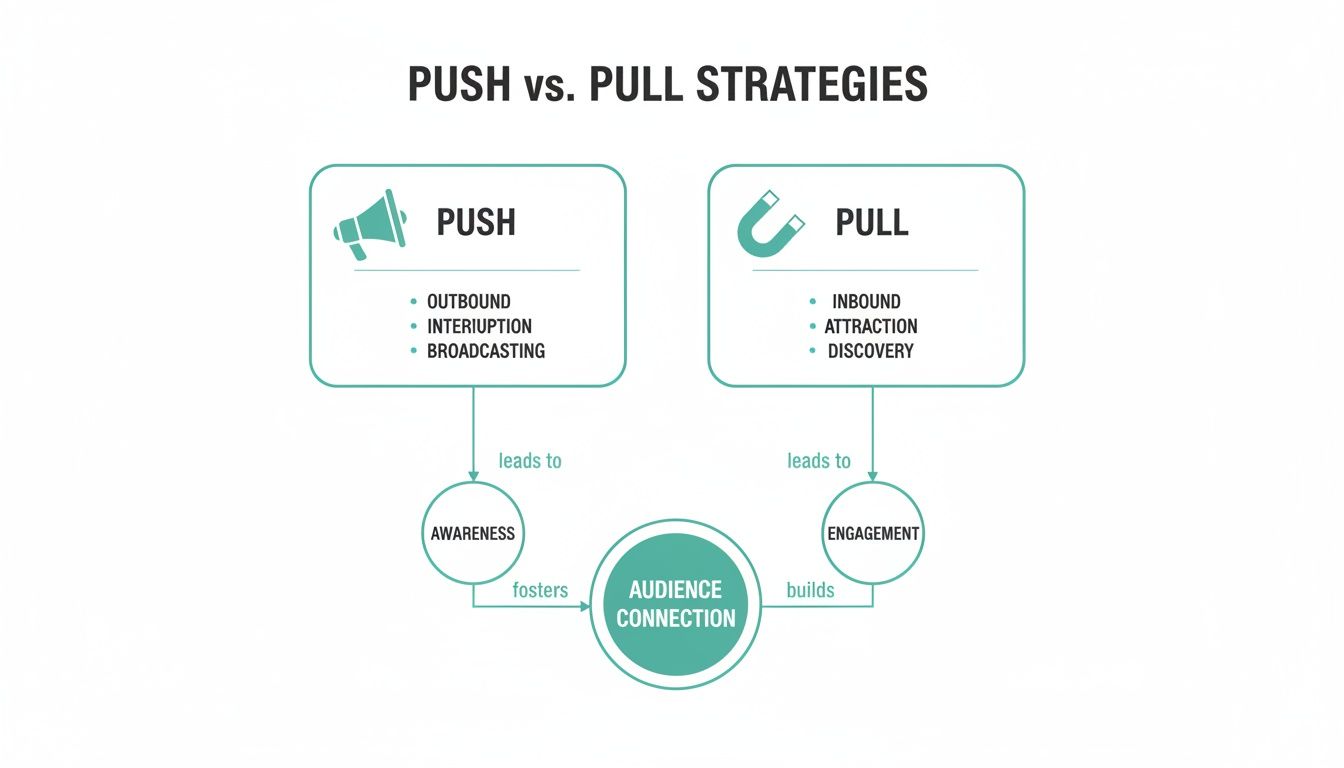
The megaphone versus the magnet is the perfect visual. One blasts a message outwards; the other draws an audience inwards. Simple as that.
Launching a New Product or Service
When you're launching something brand new, nobody is searching for it. Why? Because they don't even know it exists.
A pull strategy is useless here. You can't attract an audience that isn't looking for you. This is prime territory for a push strategy. Your only job is to create awareness from absolute zero. You have to interrupt people's days and show them what you've built.
A couple of real-world examples:
- A tech startup with a new project management tool isn't going to get organic traffic on day one. Instead, they'll run hyper-targeted LinkedIn and Facebook ads aimed squarely at job titles like "Operations Manager" or "Head of Product."
- A snack company introducing a new flavour of crisps will run TV ads and pay for those premium display spots right at the supermarket checkout. They need to grab attention when people are in buying mode.
Entering a New Market
The same logic applies when you expand into a new country or target a new demographic. Your brand recognition is likely zero. A push strategy is the only way to build a beachhead and establish your name before the local competition even knows you've arrived.
You have to announce your presence with a bang. For instance, if a well-known Asian electronics company decided to launch a new line of home appliances in North America, they wouldn't just write blog posts. They’d hit the ground running with direct mail campaigns in target neighbourhoods, run ads on local radio, and put up billboards on major commuter routes.
By directly targeting potential customers, a push strategy can accelerate the market penetration process, helping a brand go from unknown to recognised in a compressed timeframe.
Driving Time-Sensitive Promotions
Push marketing was practically built for promotions with a ticking clock. Think weekend flash sales, seasonal clearances, or any kind of limited-time offer. The whole point is to create urgency and force an immediate decision.
Pull tactics like SEO are way too slow for this kind of campaign. You can't wait weeks for a blog post to rank when your sale ends in 48 hours. You have to push the message out to as many relevant people as you can, right now.
Here are a few classic plays:
- Retail: A local furniture shop with a "Black Friday" event will blanket the area with direct mail flyers and run targeted social media ads showing the exact discounts.
- B2B: A SaaS company needs to hit its quarterly numbers. They'll blast their lead database with an email announcing a two-day-only discount on annual plans.
Executing this kind of direct outreach smoothly depends on having your tech stack in order. Understanding how your marketing automation and CRM work together is non-negotiable for getting these campaigns out the door effectively.
At the end of the day, a push strategy is your tactical weapon for situations that demand speed, control, and immediate impact. It’s not about building slow-burn relationships; it’s about making things happen on your timeline.
When a Pull Marketing Strategy Makes Sense
While push marketing gets you eyeballs fast, a pull marketing strategy is how you build something that lasts. Think of it as your game plan for sustainable, long-term growth. It’s the right call when you want to build an audience that actually seeks you out because they trust your brand and genuinely value your expertise.
The whole approach is about becoming a destination, not an interruption. This fits perfectly with the modern buyer who’d rather do their own research and find solutions on their own time, instead of being sold to.
100% Free Lead Magnet Audit
Our AI analyzes your website and delivers custom growth strategies in seconds.
Establishing Brand Authority and Trust
In a noisy market, just being the loudest doesn't win you the game. A pull strategy is all about becoming the most trusted voice in the room. By consistently putting out high-quality, genuinely helpful content, you start to build a reputation as the go-to authority.
When potential customers see you as a reliable source of information, they’ll naturally think of you when they’re finally ready to buy. That’s how you build a loyal following that sticks around.
A perfect example is a B2B software company that creates deep-dive tutorials solving a specific industry headache. This content pulls in professionals who are actively looking for answers, positioning the company as an expert long before a sales call ever happens. If you want to dive deeper into building influence this way, you can learn more about thought leadership marketing.
Capturing High-Intent Organic Leads
A pull strategy is practically designed to attract customers who are already deep in the research phase of their buying journey. These folks are hammering search engines, looking for answers and comparing their options. The intent to buy is already there, and it’s incredibly high.
By optimising your content for the right keywords (Search Engine Optimisation), you position your brand to show up at the exact moment a potential customer needs you most.
- For a SaaS company: Ranking for terms like "best project management tool for small teams" puts them right in front of qualified buyers.
- For a D2C brand: Optimising for "organic cotton baby clothes" attracts parents who are already set on buying a specific type of product.
This approach delivers leads that are almost always more qualified and easier to close than anything you'd get from interruption-based push tactics. One of the smartest ways to do this is by creating useful, interactive tools; we explore this in detail in our article on engineering as marketing.
Pull marketing isn't about finding customers; it's about making it dead simple for the right customers to find you. The focus shifts from outbound volume to inbound value, attracting leads who are already halfway to making a decision.
Fostering Long-Term Customer Relationships
Unlike the one-and-done feel of many push campaigns, pull marketing is about nurturing relationships over time. You provide value first, building a foundation of trust before ever asking for the sale. This is how you cultivate a real community around your brand.
Think of a direct-to-consumer brand using influencer reviews and user-generated content to build social proof. This doesn't just attract new buyers; it reinforces the decisions of existing customers, turning them into your biggest advocates. It’s clear that pull marketing works—just look at how platforms like search and social media dominate ad spend by effectively drawing consumers in.
At the end of the day, pull marketing is an investment in your brand's future. It takes patience and consistency, but the payoff is a resilient business with a dedicated customer base that drives predictable, organic growth.
Creating a Hybrid Strategy for Maximum Impact

The real conversation isn’t push versus pull. It’s about making them work together. The smartest marketing teams don't pick one engine; they build a hybrid that uses the short-term burst of push tactics to power the long-term, sustainable engine of pull marketing.
This creates a powerful feedback loop. Push campaigns grab initial attention and drive traffic. Your pull assets then capture that attention, turning fleeting interest into real brand equity. It’s a system where each side makes the other stronger, delivering results neither could manage on its own.
Using Push to Amplify Pull
Your in-depth guides, webinars, and pillar blog posts are fantastic—but only if people find them. Just waiting for organic discovery is a slow, painful, and unpredictable game. This is where push tactics become your secret weapon.
Instead of passively waiting for an audience, you use targeted push campaigns to deliver your best content directly to them. You get your pull assets in front of the right eyeballs, fast.
Here’s what that looks like in the real world:
- Promoting a Webinar (Pull): You’ve poured hours into a killer webinar that solves a huge problem for your ideal customer. Don't just hope they sign up. Run targeted LinkedIn ads (Push) aimed at professionals with the exact job titles who need to hear what you have to say.
- Boosting a Guide (Pull): Your team just published the definitive guide on a key industry topic. To get the ball rolling, you fire off a promotional email (Push) to your entire contact list, driving immediate traffic and downloads.
This simple blend transforms your content from a passive library asset into an active lead-gen machine. The push tactic provides the spark, and the pull asset delivers the value that builds an actual relationship.
Nurturing Push-Generated Leads with Pull Assets
It works the other way, too. Push activities like trade shows or cold outreach are great for filling the top of your funnel with contacts. The problem? Most of these leads are ice-cold and need a lot of warming up before they’re ready to even think about buying.
This is where your library of pull content becomes your sales team’s best friend. Instead of hitting them with another sales pitch, you guide these new contacts toward valuable resources that help them understand their own problems and how you solve them.
A hybrid model ensures no lead goes cold. Push tactics crack open the door, and pull content provides the warm, valuable conversation that walks a prospect through their journey.
For instance, you connect with a promising lead at a conference. The next day, you send a follow-up email pointing them to a relevant case study or a resource hub on your website. Just like that, you’ve shifted the conversation from a sales pitch to a value-add, building trust and positioning your brand as the expert.
Bridging the Gap with Interactive Lead Magnets
One of the most powerful ways to merge push and pull is with an interactive lead magnet. Tools like quizzes, calculators, and audits act as the perfect bridge. They offer immediate, personalised value (a pull characteristic) while being promoted through direct channels (a push tactic).
Picture a B2B company running a paid social ad (push) promoting a free "Marketing ROI Calculator" (pull). The ad interrupts the user's scroll, but the destination isn't a sales page. It's a tool that provides instant, useful insight. The user gets pulled deeper into the company’s ecosystem not by a pitch, but by a genuinely helpful experience.
This approach gives you the best of both worlds. The push ad creates awareness, and the interactive tool captures high-intent leads by proving your expertise on the spot. If you’re struggling to create a compelling interactive asset, you could use a tool for ideas. For example, the free lead magnet audit from Magnethive can generate a comprehensive report with AI-powered ideas for tools that serve as a powerful pull mechanism, along with its potential ROI impact.
Measuring Success With the Right KPIs
Here's a hard truth: a marketing strategy without the right metrics is just expensive guesswork. For both push and pull marketing, knowing which Key Performance Indicators (KPIs) to track is the only way to figure out what's working and prove you're not just burning cash.
But you can't use the same dashboard for both. The KPIs for each are fundamentally different because they’re chasing opposite goals.
Push marketing is all about immediate impact and getting in front of as many eyeballs as possible. Its metrics measure how well you grab attention and force a direct response. Think short-term wins.
Pull marketing, on the other hand, is the long game. It’s about building an asset—an engaged audience that seeks you out. The KPIs here track sustainable growth and the quality of the audience you’re building over time.
Breaking down what you should actually be measuring for each is critical.
KPIs for Push Marketing Campaigns
When you’re running a push campaign, you need to know if your interruption is working right now. Your dashboard should be obsessed with efficiency and direct action. It needs to answer one question: "How many people did we reach, and how many of them did what we wanted?"
You're looking for quick feedback loops. The key metrics to have on your screen are:
- Ad Impressions: The raw number of times your ad was shown. This tells you about your overall reach. It’s your baseline for brand awareness.
- Click-Through Rate (CTR): The percentage of people who saw your ad and actually clicked it. This is your number one indicator for whether your creative and messaging are hitting the mark.
- Cost Per Acquisition (CPA): How much you paid to get one new customer. This is the ultimate bottom-line metric. If your CPA is too high, you're losing money, plain and simple.
KPIs for Pull Marketing Strategies
With pull marketing, you can relax a bit on the instant-gratification metrics. The focus shifts entirely to engagement, audience quality, and the long-term value of the assets you’re creating (like your blog or YouTube channel).
You’re not measuring interruptions; you're measuring attraction. Your KPIs should tell you how well you're drawing in the right people who are actively looking for solutions you provide.
The important numbers to track here include:
- Organic Traffic Growth: The month-over-month increase in visitors from search engines. This shows your SEO efforts are paying off.
- Keyword Rankings: Where you show up in Google for your target keywords. Climbing from page two to the top three spots is a massive win that directly translates to more inbound traffic.
- Content Conversion Rate: The percentage of visitors who take a specific action after reading your content, like downloading an ebook or signing up for your newsletter. This measures the quality and persuasiveness of your content.
- Customer Lifetime Value (CLV): The total revenue you can expect from a single customer. Leads generated through pull marketing often have a much higher CLV because they came to you with a pre-existing need.
Choosing the right KPIs is crucial for understanding the health and effectiveness of your marketing efforts. This table summarises the key metrics for both push and pull strategies to help you focus on what truly matters.
| Strategy | Primary KPIs | Focus |
|---|---|---|
| Push Marketing | Impressions, Click-Through Rate (CTR), Cost Per Acquisition (CPA) | Immediate impact, reach, and direct response efficiency. |
| Pull Marketing | Organic Traffic, Keyword Rankings, Content Conversion Rate, CLV | Long-term growth, audience quality, and sustainable asset building. |
Ultimately, a well-defined set of KPIs turns your marketing from a cost centre into a predictable revenue driver. To build a truly robust dashboard, it's worth diving deeper into a comprehensive list of B2B Marketing KPIs to ensure you're tracking every stage of the funnel accurately.
Push vs. Pull: Your Questions Answered
Alright, let's cut through the noise. Understanding the difference between push and pull marketing is one of those things that seems simple at first, but the real magic is in the details. Here are the common questions I hear all the time.
How Do I Choose Between Push and Pull?
Stop thinking "either/or." The real question is, "what do I need right now?"
If you're launching a new product, running a flash sale, or need to generate buzz fast, you need push. It’s your megaphone. But if you're playing the long game—building a brand people trust, creating a sustainable source of organic leads, and fostering real customer loyalty—then pull is your engine. One is a sprint, the other is a marathon.
Can a Small Business Even Afford Push Marketing?
Yes. Forget the pricey TV commercials and billboard fantasies. Digital channels blew the doors wide open on push marketing, making it accessible for pretty much anyone with a budget.
Small businesses can get surgical with their targeting and spending using:
- Social media ads: Hit up specific job titles and demographics on platforms like LinkedIn or Facebook without breaking the bank.
- Pay-per-click (PPC) ads: Show up the exact moment someone searches for a solution you offer. It's direct and potent.
- Email marketing blasts: Got a time-sensitive offer? A targeted email blast to a segmented list is still one of the most direct ways to drive action.
Which Strategy Has a Better ROI?
This is a trick question. They're optimised for different kinds of returns, and anyone who gives you a single answer is selling something.
Push marketing often gives you a faster, more direct ROI you can measure on a spreadsheet. You spend X on ads, you get Y in sales. Simple. But once you turn off the ads, the sales often dry up.
Pull marketing is different. It's like building an asset. That killer blog post, that top-ranking SEO keyword, that loyal email list—they keep delivering value long after you've put in the initial work. The ROI is harder to track on a weekly basis, but over the long run, it's almost always higher thanks to organic traffic and a much healthier customer lifetime value (CLV).
How Do Push and Pull Actually Work Together?
This is where the pros separate themselves from the amateurs. They don't see them as opposing forces; they see them as two parts of the same machine.
You use push tactics to get your pull content in front of more eyeballs. Got a brilliant guide or an interactive calculator? Don't just wait for people to find it—run targeted ads pointing directly to it.
On the flip side, use your pull content to nurture the leads you grabbed from a push campaign. Did you collect a bunch of business cards at a trade show? Don't just hit them with a sales pitch. Send them your most valuable content to build trust first. This hybrid approach is how you turn fleeting attention into a solid, long-lasting brand.