Push n pull marketing: A B2B Demand Gen Guide
Discover push n pull marketing for B2B demand gen. Compare channels, tactics, and timing to capture and create high-quality leads.
When you boil it all down, demand generation really comes down to two moves: push and pull. Push marketing is about getting your message in front of people who aren’t looking for it. You’re creating demand. Pull marketing, on the other hand, is about being there when someone is already looking for a solution. You’re capturing demand.
Defining the Core of B2B Demand Generation

In the B2B world, predictable, high-quality demand is the engine that drives growth. That engine runs on the constant interplay between push and pull. One creates the initial spark of interest; the other is there to fan the flame when that spark turns into real intent.
This isn't about picking a winner. It's about knowing when and how to use each one to get the best results. A truly resilient strategy blends both, building a system that can create new opportunities out of thin air while also snagging the ones that are already out there. Getting this right is foundational to building a high-converting B2B marketing funnel.
A Quick Comparison
Here's a straightforward breakdown of what makes these two strategies so different. This table lays out how they approach the same goal: reaching potential customers.
| Dimension | Push Marketing (Creating Demand) | Pull Marketing (Capturing Demand) |
|---|---|---|
| Approach | Outbound and proactive. You’re starting the conversation. | Inbound and reactive. You’re attracting active searchers. |
| Audience Mindset | Passive; not actively looking for a solution right now. | Active; researching a specific problem or need. |
| Primary Goal | Build awareness and generate that first flicker of interest. | Provide solutions and convert prospects with high intent. |
| Typical Channels | Paid social ads, display ads, cold email, content syndication. | SEO, paid search (PPC), content marketing, review sites. |
The real difference-maker here is intent. Push marketing targets people based on who they are (their job title, their industry), hoping to make them realise they have a need. Pull marketing targets people based on what they do (what they search for), capturing a need they already know they have.
Think of it this way: a B2B SaaS company might run a LinkedIn ad campaign (a push tactic) to show off a new analytics tool to finance leaders. The goal is just to make them aware that a better way of doing things even exists.
At the very same time, that company would use pull tactics, like writing in-depth blog posts optimised for keywords like "best analytics software for finance teams." This captures the people who are already shopping around and comparing their options.
Throughout this guide, we'll get into the weeds on the specific channels, interactive tools, and measurement frameworks for both. You won't just learn the definitions—you'll learn how to build a powerful engine that drives predictable growth for your B2B organisation.
Exploring Pull Marketing: Capturing Demand That's Already Looking for You

Pull marketing isn't about chasing people down. It’s about being the destination they were already trying to find.
Instead of interrupting someone’s day with an ad, you make your business the best, most obvious answer to questions they're already typing into Google. This is all about targeting people with high intent – they know they have a problem and they’re actively hunting for the solution.
The entire strategy pivots on one thing: understanding what your audience is searching for and creating ridiculously valuable resources that show up at that exact moment. You're not buying attention; you're earning it. You become a magnet for qualified leads.
The Power of Being the Answer
Think about the mindset. Someone engaging with pull marketing isn’t just scrolling through a feed; they’re on a mission. They have a problem to solve right now.
This makes them incredibly receptive to your message. It’s why this approach often leads to much higher conversion rates and shorter sales cycles than most push tactics. Your job is to meet them at their point of need with the perfect piece of content or the right tool.
This is where channels like organic search, paid search, and smart content marketing really shine.
- Organic Search (SEO): This is the long game. You optimise your site and content to rank for specific keywords, building authority and a steady stream of high-quality traffic over time. A practical example is HubSpot, which ranks for thousands of marketing and sales-related terms by creating comprehensive guides and free tools.
- Paid Search (PPC): This is your shortcut to the top. You pay to place ads for hyper-targeted keywords, giving you immediate visibility and capturing demand from people ready to buy. For instance, a company like Salesforce might bid on "CRM software for small business" to appear at the top of search results.
- Content Marketing: This is the fuel for both SEO and PPC. It’s the actual "answer" searchers are looking for—whether it's an in-depth guide, a compelling case study, or an interactive tool that solves a very specific problem.
The heart of pull marketing is a simple value exchange. A prospect gives you their attention—and maybe their contact details—because you first gave them something genuinely useful. An answer, a tool, a clear path forward.
Your Content Must Match the Search Query
Success here demands a deep, almost obsessive, understanding of what your audience is searching for. It's not about targeting broad, generic terms. It’s about digging into the specific pain points hidden in long-tail keywords.
For instance, a B2B SaaS company selling finance software doesn’t just go after "accounting software." That’s a losing battle.
Instead, they build specific assets for queries like:
- "how to automate accounts payable for small business" (Perfect for a detailed blog post or guide)
- "best Quickbooks alternative for manufacturing" (Demands a sharp, honest comparison page)
- "roi of upgrading financial planning software" (Screaming out for an interactive calculator)
Each piece of content is engineered to be the definitive answer for that one specific search. When someone lands on your page, their first thought should be, "Yes, this is exactly what I was looking for." That alignment is what turns traffic into actual leads.
Capitalising on Search Intent
Even as other channels explode, search marketing remains a solid pillar because it's where intent is most explicit. Experts forecast an 8% growth in search ad spend for 2025. While that might seem modest next to retail media’s massive 24% surge, it shows just how reliable search is. With digital ad spend projected to hit 63% of the total by 2029, being visible on search is non-negotiable.
This pull dynamic is gold for demand gen managers. The customer journey almost always starts with a search. Having an optimised landing page, perhaps with an interactive assessment, is how you turn a simple query into a qualified lead.
The most effective pull strategies are now built around interactive tools. When a prospect is deep in research mode, an ROI calculator or a self-assessment tool gives them instant, personalised value that a blog post just can't match. This is how you stand out from the noise.
Mastering Push Marketing: How to Create Demand Out of Thin Air
Push marketing is all about starting a conversation your audience didn't even know they needed to have. You’re not waiting for them to search for a solution; you're showing up and pointing out a problem they haven't fully recognised yet.
Think of it this way: instead of waiting for someone to find you, you find them. The entire goal is to interrupt their day with a message so sharp and relevant it makes them stop scrolling and think. You’re introducing a new idea or a better way of doing things before they've even typed a single letter into Google.
This isn’t about shouting into the void, though. It requires a deep, almost obsessive understanding of your ideal customer. You need to know their job title, their biggest headaches, and where they hang out online. Get that right, and your interruption feels less like an ad and more like a genuinely helpful heads-up.
The Go-To Channels for Proactive Outreach
Let's get practical. Where does push marketing actually happen? While the channels differ, they all share one critical ingredient: precision targeting. It’s about getting your message in front of the right people.
Good push marketing isn’t about being annoying. It's about delivering a valuable insight to a specific group of people who stand to benefit from it, even if they aren't looking for help just yet.
- Paid Social Ads: For B2B, LinkedIn is the undisputed king. You can target people with surgical precision based on their job title, company size, industry—you name it. A practical example is an enterprise software company running an ad campaign targeted specifically at "Chief Technology Officers" in the financial services sector.
- Targeted Display Advertising: This is about placing visual ads on the websites your audience already visits. Thanks to modern programmatic advertising, you can show your ads only to users who fit a very specific demographic and firmographic profile. It's the digital equivalent of putting a billboard right outside their office.
- Content Syndication: Here, you’re promoting your best content (think whitepapers or in-depth eBooks) on third-party publisher sites. You're "pushing" your expertise in front of an established, relevant audience, borrowing their credibility to build your own.
- Strategic Outbound Email: Forget spammy mass emails. A smart outbound campaign is about sending highly personalised emails to a small, carefully chosen list of prospects. The message zeroes in on a single pain point that's highly relevant to their role and industry.
The secret to a great push strategy is to interrupt without being intrusive. Your creative and messaging have to be compelling enough to stop someone mid-scroll and make them think, "Huh, this is actually for me."
Using Interactive Tools as a Push Tactic
Here’s where things get really clever. One of the most effective ways to run a push campaign is by promoting an interactive tool. Imagine running a LinkedIn ad that doesn't push a product, but instead pushes a free diagnostic quiz or a maturity assessment.
This works brilliantly because it doesn't feel like a hard sell. You're offering a valuable, personalised experience. Prospects engage, answer questions about their own work, and get instant feedback. In that process, they often uncover a blind spot or a pain point they hadn't fully appreciated before.
Just like that, a passive scroller becomes an active lead. They've literally just told you they have a problem, and you’ve captured incredibly valuable zero-party data to tailor your follow-up. You've created genuine demand where, just moments earlier, none existed. If you need some AI-powered ideas for your next high-converting lead magnet, you can get a free analysis with our lead magnet audit tool, Magnethive.
This approach is gaining serious traction. The market is seeing a projected 24% year-over-year growth in retail media networks for 2025, where brands push products to shoppers at the digital point of sale. B2B is adapting this playbook, using platforms like TikTok to push interactive assessments to highly targeted audiences. You can find more details about these retail media trends here.
Strategic Comparison: When to Push and When to Pull
Deciding between push and pull marketing isn’t a coin toss. It’s a strategic calculation based on your goals, where you stand in the market, and who you’re actually trying to talk to. Getting past the generic pros and cons to break down when to use each strategy across the B2B dimensions that actually matter is key.
Think of it like picking the right tool for the job. You wouldn't use a sledgehammer to hang a picture, and you wouldn't use a tiny screwdriver to break down a wall. The context of your campaign dictates everything.
Lead Intent and Urgency
The core difference between push and pull comes down to the prospect's mindset. Pull marketing is all about people who are already problem-aware and actively looking for a solution. Their intent is high, and their need is often right now.
- Pull Marketing: This is for high-intent leads. Someone Googling "best project management software for agencies" is already in the game. They're comparing options and are much closer to making a decision, which means shorter sales cycles for you.
- Push Marketing: This is for low-intent or totally unaware audiences. A project manager scrolling through their LinkedIn feed isn't hunting for new software. Your ad has to grab their attention and make them realise they even have a problem (e.g., "Tired of missed deadlines?"). You’re creating the intent from scratch.
This distinction is massive for your budget. Pull marketing spends money to capture existing demand. Push marketing invests money to create future demand.
Cost Per Acquisition and Scalability
The financial side of each strategy is also fundamentally different. Of course, costs vary, but some general patterns hold true for most B2B companies.
Pull marketing, especially through organic channels like SEO, often has a much lower long-term Cost Per Acquisition (CPA). It’s an investment that compounds; one high-ranking article can bring in leads for years. The catch? Its scalability is capped by how many people are actually searching for your solution. You can only capture the demand that exists.
Push marketing, on the other hand, usually has a higher initial CPA. You're paying to get in front of a colder audience. But its biggest advantage is scalability. You aren't limited by search volume; you can reach as many people as your targeting and budget will allow.
If you’re launching a disruptive tech product in a new category no one is searching for yet, push isn't just an option—it's your only move. You have to push your message out there to educate the market and build that initial awareness.
Unsure what kind of interactive tool could support a push campaign like that? Getting a free analysis from a tool like Magnethive can generate AI-powered ideas for quizzes or calculators that actually engage cold audiences effectively.
100% Free Lead Magnet Audit
Our AI analyzes your website and delivers custom growth strategies in seconds.
Sales Cycle Velocity and Brand Equity
How fast a lead moves through your funnel is directly tied to where they came from. Leads from pull channels almost always move faster.
They started the search, so they're already educated and motivated. The sales conversation begins from a place of shared understanding, which dramatically shortens the trip from MQL to a signed deal.
Push-generated leads need a lot more nurturing. They came in at the very top of the funnel—the awareness stage. The sales cycle is naturally longer because you first have to teach them about the problem before you can even start talking about your solution.
When it comes to brand equity, both strategies play a different role:
- Pull Marketing builds authority and trust. By consistently giving the best answers to your audience's questions, you become the go-to resource. This builds deep, lasting brand equity.
- Push Marketing builds awareness and reach. It gets your brand name in front of a massive, targeted audience, creating recognition and recall. This is crucial for getting a foothold in a crowded market.
To make this clearer, here's a side-by-side breakdown of the key strategic differences.
Push vs Pull Marketing: A Situational B2B Comparison
This table cuts through the noise and provides a straightforward look at how Push and Pull marketing stack up across the performance indicators and use cases that matter most in B2B.
| Dimension | Pull Marketing (Capturing Demand) | Push Marketing (Creating Demand) |
|---|---|---|
| Lead Intent | High; prospect is actively seeking a solution. | Low to none; prospect is passive or unaware of the problem. |
| Typical CPA | Lower in the long term but capped by search volume. | Higher initially but highly scalable beyond existing demand. |
| Sales Cycle | Faster; leads are pre-qualified and problem-aware. | Slower; leads require extensive nurturing and education. |
| Brand Impact | Builds deep authority, trust, and credibility over time. | Generates broad awareness, name recognition, and market presence. |
| Best For | Established markets, capturing existing demand, high-LTV products. | New products, disruptive tech, creating a new category. |
Ultimately, a winning strategy doesn't choose one over the other. It masterfully blends them. You use push to fill the top of your funnel and create future demand, while using pull to efficiently capture the high-intent prospects who are ready to buy today.
How to Weave Push and Pull Together with Interactive Content
The smartest demand gen engines don't treat push and pull marketing like two separate playbooks. They don't run one campaign over here and another over there. Instead, they weave them into a single, cohesive strategy where each tactic makes the other one stronger.
The secret to making this work? You need a central hub that can serve both your proactive outreach (push) and your inbound interest (pull). And honestly, nothing bridges that gap better than interactive content.
Interactive tools like quizzes, assessments, and calculators are ridiculously versatile. They can be a magnet for high-intent prospects who are actively looking for solutions (pull). But they can also be a compelling hook to grab the attention of a cold audience that doesn’t even know they have a problem yet (push). This dual-purpose nature makes them the perfect connection between both sides of your funnel.
You can build an entire integrated campaign around just one high-value interactive asset. This keeps your efforts efficient, your messaging consistent, and your ability to capture rich customer data on point.
The Blueprint for an Integrated Campaign
Let's walk through a real-world blueprint. We'll use an interactive ROI calculator as our central asset. This kind of tool is gold for B2B buyers, helping them put a real number on the financial benefit of using your solution. It’s valuable at pretty much every stage of their journey.
Here’s a simple decision tree to visualise when to lean into a push or pull approach.
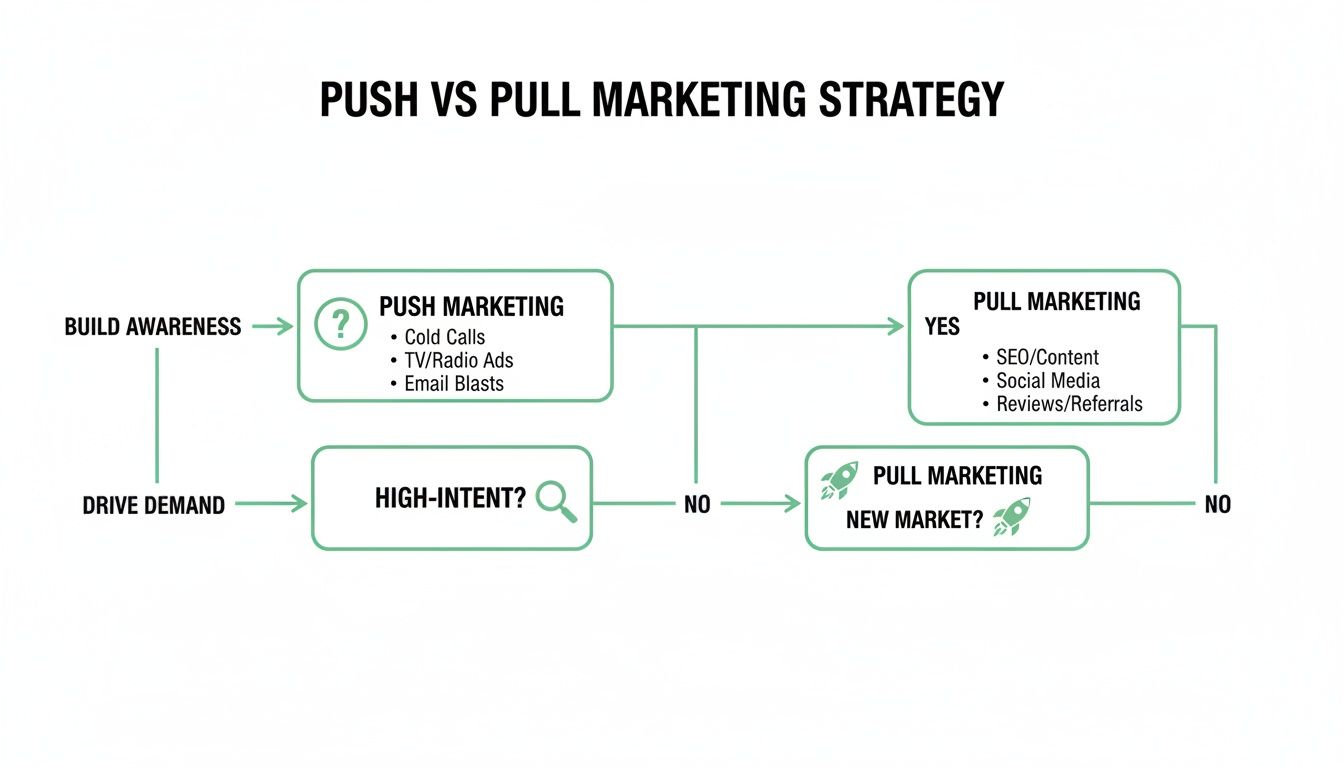
As the flowchart shows, pull marketing is your go-to for capturing existing, high-intent demand. Push marketing is what you need when you're breaking into new markets or just trying to build awareness from a cold start.
Step 1: The Pull Component (Capturing Existing Demand)
First up, we build the pull foundation. The ROI calculator becomes the star of its own dedicated, SEO-optimised landing page.
- Target High-Intent Keywords: We're going after long-tail keywords that scream "I'm ready to buy," like "[Your Solution] ROI calculator" or "cost savings from [Your Industry] software."
- Create Genuinely Valuable Content: This isn't just a form slapped on a page. It's surrounded by content that explains the how and why behind the calculation, features case studies, and answers common questions. This builds trust and positions you as an authority.
- Capture Inbound Leads Smoothly: When someone finds this page through a search, they're already on a mission. The calculator gives them an immediate, personalised answer, making the trade for their contact info feel more than fair.
This setup makes sure you're catching all the demand that’s already out there, turning motivated searchers into qualified leads with almost zero friction. If you want some inspiration, check out these powerful interactive marketing examples that absolutely crush engagement.
Step 2: The Push Component (Creating New Demand)
Now, we take that exact same calculator and use it for our push marketing. The goal here is to introduce this valuable tool to a very specific cold audience—people who aren't searching for it but would find it incredibly relevant if they saw it.
For this, our main channel is a paid social campaign on LinkedIn.
- Define a Laser-Focused Audience: We target users by job title ("VP of Operations"), industry ("Manufacturing"), and company size. This way, the ad only shows up for people who will genuinely get value from the calculator.
- Craft an Ad That Offers, Not Sells: The ad creative doesn't pitch a product; it offers a free tool. The copy hits on a common pain point: "Wondering how much inefficient processes are costing you? Find out in 60 seconds."
- Drive Traffic Directly to the Tool: The ad's call-to-action sends them straight to the ROI calculator. They get instant value, and in return, you get critical zero-party data about their specific business challenges.
This integrated approach is incredibly efficient. You create one high-value asset and use it to both capture existing demand and create new demand, maximising your return on the content's creation.
The data you gather from the calculator—things like company size, current costs, and biggest operational headaches—lets you create hyper-personalised follow-up sequences. You're no longer guessing at a lead's pain points. They've literally just told you what they are. This lets your sales team start conversations that are immediately relevant and valuable from the very first touch.
Building a Unified Push and Pull Measurement Scorecard
An integrated strategy falls apart without integrated measurement. It’s that simple. If you’re running both push and pull marketing, looking at performance in separate silos is a recipe for disaster. To see what’s actually working, you need a unified scorecard that shows how each tactic contributes to the bigger picture.
This means you’ve got to move beyond channel-specific metrics. Start looking at how your push and pull activities influence each other and drive actual business growth. A unified view is the only way you can prove ROI, make smarter budget decisions, and stop guessing about your marketing mix.
Key Metrics for Pull Marketing
With pull marketing, you’re capturing existing demand. These people are already looking for what you sell, so your metrics need to show how well you’re attracting and converting this high-intent traffic.
Focus on these pull metrics:
- Organic Keyword Rankings: Are you even visible when your ideal customer is searching? Tracking your position for high-intent keywords is non-negotiable.
- Click-Through Rate (CTR) from SERPs: Of all the people who see your site in the search results, what percentage actually clicks? A low CTR is a huge red flag that your titles and meta descriptions aren't hitting the mark.
- Lead Conversion Rate: Once they’re on your site, how many visitors turn into qualified leads? This is the ultimate test of your landing page and content.
Key Metrics for Push Marketing
Push marketing is a completely different beast. You’re creating demand where none existed. So, the metrics change. Here, you’re measuring your ability to grab attention and spark interest in an audience that wasn’t actively looking for you.
Your essential push metrics are:
- Impression Share: How much of your target audience are you actually reaching? This tells you if your ads are getting in front of enough of the right people.
- Cost per MQL (Marketing Qualified Lead): How much does it cost to generate a lead that meets your criteria? This is a critical efficiency metric for your outbound campaigns.
- Engagement Rates: On platforms like LinkedIn, this means likes, comments, and shares. High engagement is a sign that your message is resonating, even with a cold audience.
A unified scorecard doesn't just list these metrics side-by-side. It connects them. It shows how a push campaign that boosts brand awareness might lead to a surge in branded organic searches—a clear win for your pull strategy.
Blended Metrics for a Holistic View
The real power of a unified scorecard comes from blended metrics. These are the numbers that cut across both strategies and give you a single source of truth about your marketing performance. They force you to look at the entire funnel, not just individual campaigns.
You absolutely need to add these to your dashboard:
- Holistic Customer Acquisition Cost (CAC): This is your total sales and marketing spend (from both push and pull) divided by the total number of new customers acquired. It gives you the true, blended cost of winning a new client. No more hiding behind vanity metrics.
- Total Lead-to-Customer Conversion Rate: Of all the leads you generate from every single channel, what percentage ultimately becomes a paying customer? This helps you understand the overall quality of your leads across the entire system.
By tracking these blended metrics, you can finally answer the big questions: Is our marketing engine getting more or less efficient? How does our investment in creating demand (push) actually affect our ability to capture it (pull)?
Getting this data connected often requires a solid setup between your analytics tools and CRM. For a deeper dive, you should explore how integrating marketing automation and CRM systems can create this single source of truth.
This unified approach turns your data from a simple report into a powerful decision-making tool. It gives you the confidence to adjust your strategy and prove the real value of your integrated marketing efforts.
A Few Final Questions You Might Have
So, what’s the real difference between push and pull marketing?
Think of it like this: Push marketing is like being a door-to-door salesperson. You’re knocking on doors (or popping up in LinkedIn feeds) trying to tell people about a solution they didn't even know they needed. You're creating demand from scratch.
Pull marketing is like setting up a shop on the busiest street in town. People are already out looking for something, and you're just making sure your shop is the most visible and appealing one they find. You’re capturing existing demand.
Okay, but when should my B2B company use push vs pull?
It’s less about "either/or" and more about "when and why."
Use push marketing when you’re launching a completely new product category or breaking into a market where nobody’s searching for what you do... yet. You have to educate the market first.
Lean on pull marketing when you're in an established space. Buyers already have a problem and are actively searching for a solution. Capturing these high-intent folks usually means a much shorter sales cycle.
We’re a small business. Can we really afford to do both?
Absolutely. You don't need a massive budget to make this work.
Start with the most cost-effective pull tactics—like consistent blogging and basic SEO—to build a solid foundation. This is your long-term asset.
Then, you can carefully layer in highly-targeted push campaigns. Think a small-budget social media ad that promotes a genuinely useful interactive tool, not just a boring PDF. That's how you get a smart, balanced push-and-pull strategy without breaking the bank.