The Strategic Shift To Push To Pull Marketing
Stop interrupting and start attracting. This guide reveals the strategic shift to push to pull marketing with B2B blueprints for creating high-quality leads.

Think of your marketing like a conversation. For decades, B2B marketing was a one-way monologue. Companies blasted their messages through cold calls, trade show booths, and banner ads, hoping something would stick.
This is push marketing. It’s the equivalent of a marketer grabbing a megaphone and shouting at anyone who will listen. It interrupts a potential customer's day.
But the B2B buyer has changed. A lot. They're no longer waiting for a sales call. They’re deep into their own research, armed with more information than ever before. This simple fact has made the old interruptive playbook pretty much obsolete.
The Inevitable Shift From Push To Pull Marketing
This is where pull marketing comes in. Instead of shouting, you use a magnet.
A pull strategy is all about creating value that naturally attracts an interested audience. It’s about being easily discoverable the exact moment a prospect is looking for answers to a problem you can solve. You stop interrupting and start attracting.
This entire approach is built on a foundation of empathy. You offer expertise and solutions upfront, building trust and credibility long before a sales conversation even begins.
The big idea behind pull marketing is to create assets that solve problems, answer questions, and build authority. You stop being just another vendor and become a go-to resource. When it's time to buy, you're the obvious choice.
To give you a clearer picture, here’s a quick breakdown of how these two approaches stack up against each other.
Push Marketing vs Pull Marketing At A Glance
| Characteristic | Push Marketing | Pull Marketing |
|---|---|---|
| Approach | Interruptive; company-centric | Magnetic; customer-centric |
| Communication | One-way broadcast (megaphone) | Two-way dialogue (conversation) |
| Goal | Generate immediate demand | Build long-term relationships |
| Audience | Broad, often untargeted | Niche, highly specific, and in-market |
| Customer Intent | Low; often unaware of the problem | High; actively seeking a solution |
| Typical Tactics | Cold calls, display ads, direct mail | SEO, content marketing, interactive tools |
| Core Metric | Impressions, reach, outbound volume | Engagement, lead quality, inbound traffic |
As you can see, the differences aren't just tactical—they represent a fundamental shift in mindset from "selling to" towards "helping."
Key Pillars Of A Modern Pull Strategy
Making the switch to a pull-first mindset means building an engine that consistently brings high-intent prospects to your door. This usually involves a few core components:
- Valuable Content: This is your foundation. Think blog posts, in-depth guides, and whitepapers that genuinely address the pain points your ideal customers are wrestling with.
- Search Engine Visibility: A huge part of being discoverable is showing up when people search. This means understanding search engine optimization (SEO) is non-negotiable for attracting people who are actively looking for what you offer.
- Interactive Experiences: This is where things get really powerful. Tools like quizzes, ROI calculators, and assessments offer immediate, personalised value. They’re insanely effective at engaging visitors and are a cornerstone of modern https://interactiveleadgen.com/blog/interactive-marketing.
Moving from push to pull isn't just a tactical switch-up; it's a complete change in philosophy. It’s about respecting the buyer's journey and earning their attention instead of demanding it.
For any B2B team serious about sustainable growth, this approach is a game-changer. It leads to better leads, shorter sales cycles, and a much healthier return on your marketing spend.
Why Your B2B Push Tactics Are Broken
The old B2B marketing playbook is gathering dust for a reason. For years, the game was simple: shout louder than everyone else. We blasted out display ads, carpet-bombed inboxes with email campaigns, and dialled for dollars with relentless cold calls. The strategy was pure brute force—if you made enough noise, someone had to pay attention.
That volume-first approach is officially on life support. The same tactics that used to fill pipelines are now struggling to justify their line item on the P&L statement. The problem isn't a lack of effort. The ground has completely shifted under our feet, and the B2B buyer has changed the rules of the game.
Your Buyers Are Tired and Blind to Your Banners
Modern B2B buyers are drowning. They're hit with thousands of marketing messages every single day, and the result is a bad case of audience fatigue. To cope, their brains have gotten incredibly good at one thing: ignoring anything that even remotely smells like a sales pitch.
This is where "banner blindness" comes in. It’s a survival instinct. Users have trained themselves to subconsciously—and consciously—ignore anything on a website that looks like an ad. Your carefully designed display ad isn't just ineffective anymore; it's become invisible background noise.
The fatal flaw of push marketing is simple: it works on the seller's schedule, not the buyer's. It shoves a message in front of people who aren't even looking for a solution, which is why it gets ignored. This is the root cause of dismal engagement and wasted ad spend.
The Math on Customer Acquisition Costs Just Doesn't Add Up
When push tactics stop working, the knee-jerk reaction is to just spend more. But throwing more cash at display ads or buying bigger email lists only leads to one thing: your Customer Acquisition Costs (CAC) go through the roof. You're paying more for progressively worse results.
This puts demand gen managers in a tough spot, constantly having to defend the ROI of interruptive, low-engagement channels. When the leads that do come through are low-quality, the cost to acquire a qualified lead becomes completely unsustainable.
This financial pressure forces a much-needed change in thinking. The question can no longer be, "How do we reach more people?" It has to be, "How do we get the right people, who are already looking, to find us?" That's the pivot from a push to a pull mindset.
The Buyer Is in the Driver's Seat Now
Maybe the biggest nail in the coffin for old-school push marketing is that the B2B buyer is now firmly in control. They run their own research process. They dig into peer reviews, consume genuinely helpful content, and build a shortlist of vendors long before they ever think about talking to a salesperson.
Think about how it really works today:
- They Start Without You: A marketing manager doesn't sit around waiting for your cold call. She’s on Google searching "best project management tools for remote teams" and diving deep into comparison articles.
- They Trust Their Peers, Not You: Before even considering a demo, she's on G2 or asking for unfiltered opinions in her professional Slack communities.
- They Engage on Their Terms: She only reaches out to a vendor once she's 80% of the way there—when she understands her problem and has a good idea of what the solution looks like.
In that context, your unsolicited email or generic ad doesn't just feel irrelevant; it feels clueless. It shows you have no idea where she is in her journey. This new reality makes a rock-solid business case for changing your approach, because a well-designed pull strategy is built to solve exactly these problems.
Engineering Pull Marketing With Interactive Tools
The best way to switch from push to pull marketing is to stop talking about solutions and start building them.
This isn’t just a small tweak; it’s a completely different mindset. It's the core of a strategy called engineering as marketing. You stop creating content that describes value and start building tools that deliver it, right then and there.
Think about it. Instead of a static PDF promising insights, you offer a tool that gives instant answers. These tools act like magnets, pulling in prospects who are actively trying to solve a real problem. By giving them immediate, personalised feedback, you create a value exchange that’s almost impossible to ignore.
The Psychology Behind Interactive Pull Marketing
Why are things like quizzes, ROI calculators, and maturity assessments so ridiculously effective? It’s because they tap into a few core psychological triggers that a blog post or a whitepaper just can't touch. These tools don't just inform; they pull the user into a conversation.
This active participation is the secret sauce. A visitor goes from being a passive reader to an active player in their own discovery.
The magic of an interactive tool is that it transforms your marketing from a monologue into a dialogue. It asks the user questions, listens to their answers, and provides a tailored result, making them feel understood and valued from the very first click.
Here’s why that dialogue is so powerful:
- It Sparks Curiosity: An assessment or a calculator hits the user with a question they genuinely want answered. "What's my marketing maturity score?" or "How much could we actually save with this software?" That curiosity is a massive motivator to engage.
- It Delivers Instant Gratification: No one likes waiting for an email reply or a demo callback. Interactive tools give answers now. This immediate payoff builds a little bit of trust and leaves a great first impression of your company's efficiency.
- It Creates a Sense of Ownership: When someone spends a few minutes answering questions, they become invested in the result. The personalised report they get feels like their data, which makes the insights stick.
Turning Visitors Into Qualified Leads With Zero-Party Data
Every time someone uses one of these tools, they're handing you a stream of priceless information called zero-party data. This is data a customer intentionally and proactively shares with you. It's the absolute gold standard for lead qualification because it comes straight from the source.
When a prospect uses your tool, they aren't just getting a score; they're telling you exactly what their challenges, goals, and current situation are.
For a practical example, consider a "Cybersecurity Risk Assessment" tool:
- A user who scores "High Risk" and also tells you they have no firewall solution in place? That's a high-priority, sales-ready lead. You need to call them yesterday.
- Another user scores "Low Risk" but mentions they're reviewing their budget in six months. They're a perfect fit for a long-term nurture sequence.
This kind of insight makes your lead scoring and funnel routing incredibly precise. It means your sales team stops wasting time on lukewarm leads and focuses only on the hottest opportunities. It’s a world away from the guesswork of qualifying someone who just downloaded an ebook. For a deeper look at how this works in practice, check out our article on engineering as marketing.
Real-World Examples of Interactive Pull Tools
This isn't just theory; these tools are proven workhorses for B2B demand gen. They are how you actually make the push to pull marketing shift happen by creating assets your customers actively search for.
Here are a few practical applications:
- ROI Calculators: A SaaS company could build a calculator that shows a prospect exactly how much money they’d save by switching platforms. The user punches in their current costs, and the tool spits out a clear, undeniable business case for making a change.
- Maturity Assessments: A consulting firm could create a "Digital Transformation Maturity Assessment." This quiz would ask about a company's current processes and tech stack, then generate a score and a report with personalised recommendations. It instantly positions the firm as the expert guide.
- Configuration Tools: A hardware manufacturer could build an online tool that helps engineers design a custom part. The tool doesn't just provide value; it captures the exact specs, generating a perfectly qualified lead that's already halfway to a purchase order.
The common thread here is value. Each tool solves a small but nagging problem for the user, establishing your company as a helpful resource, not just another vendor trying to sell something. If you want to see this in action, you can analyze your own assets with a tool like Magnethive. As a free lead magnet audit tool, it generates a comprehensive report with AI-powered ideas and shows potential ROI impact, perfectly demonstrating a 'pull' tool that provides immense value upfront.
A Blueprint For Your First Pull Marketing Tool
Talking about pull marketing is one thing, but actually building your first tool is where the magic happens. It might sound like a massive technical challenge, but it really just boils down to a simple, repeatable process. This is the blueprint to take you from a vague idea to a high-value asset that pulls in qualified leads while you sleep.
The core idea is laughably simple: find a painful, recurring question your audience has and build a tool that answers it for them. Right away, you've created a value exchange that a static blog post could never hope to match.
Step 1: Identify a High-Value Problem
Your tool’s success lives or dies by this step. You need to solve a problem your ideal customers are genuinely trying to fix. This isn’t about guessing what they need; it’s about discovering what keeps them up at night. The best problems are almost always tied to cost, risk, or efficiency.
So, where do you find these golden nuggets? Start by listening to the people on the front lines.
- Talk to Sales: What are the top three questions prospects always ask on discovery calls? What numbers are they scribbling on a napkin, trying to figure out?
- Talk to Customer Support: What problems do your existing customers wrestle with constantly? Are there common setup or optimisation questions you could turn into a self-serve tool?
- Analyse Search Data: Look at what people are typing to find you. Keywords containing phrases like “how to calculate,” “cost of,” or “am I ready for” are absolute goldmines for tool ideas.
For example, a cloud hosting company likely hears, "How much is this actually going to cost us per month?" constantly. That's the perfect seed for a 'Cloud Cost Calculator'. Or if you're a cybersecurity firm, you could build a 'Cybersecurity Risk Assessment' based on the security anxieties you hear from clients every day.
100% Free Lead Magnet Audit
Our AI analyzes your website and delivers custom growth strategies in seconds.
Step 2: Design the Logic and User Experience
Got your problem? Great. Now, you must design the tool. The most important word here is simplicity. A great pull marketing tool shouldn't feel like you're filling out your tax returns. It needs to be quick, intuitive, and laser-focused on delivering a clear result.
First, map out the logic. What information do you absolutely need from the user to give them a valuable answer? For that 'Cloud Cost Calculator', you'd need inputs like server count, data storage, and maybe bandwidth. For a risk assessment, you’d use simple multiple-choice questions about their current security setup.
The user experience (UX) is non-negotiable. Your tool has to be clean, easy to navigate, and work flawlessly on a phone. A clunky or confusing interface will absolutely destroy your conversion rate, no matter how good the final result is.
This diagram nails the fundamental flow: you grab a user's curiosity with a question, deliver instant value with a calculation, and get high-intent data in return.
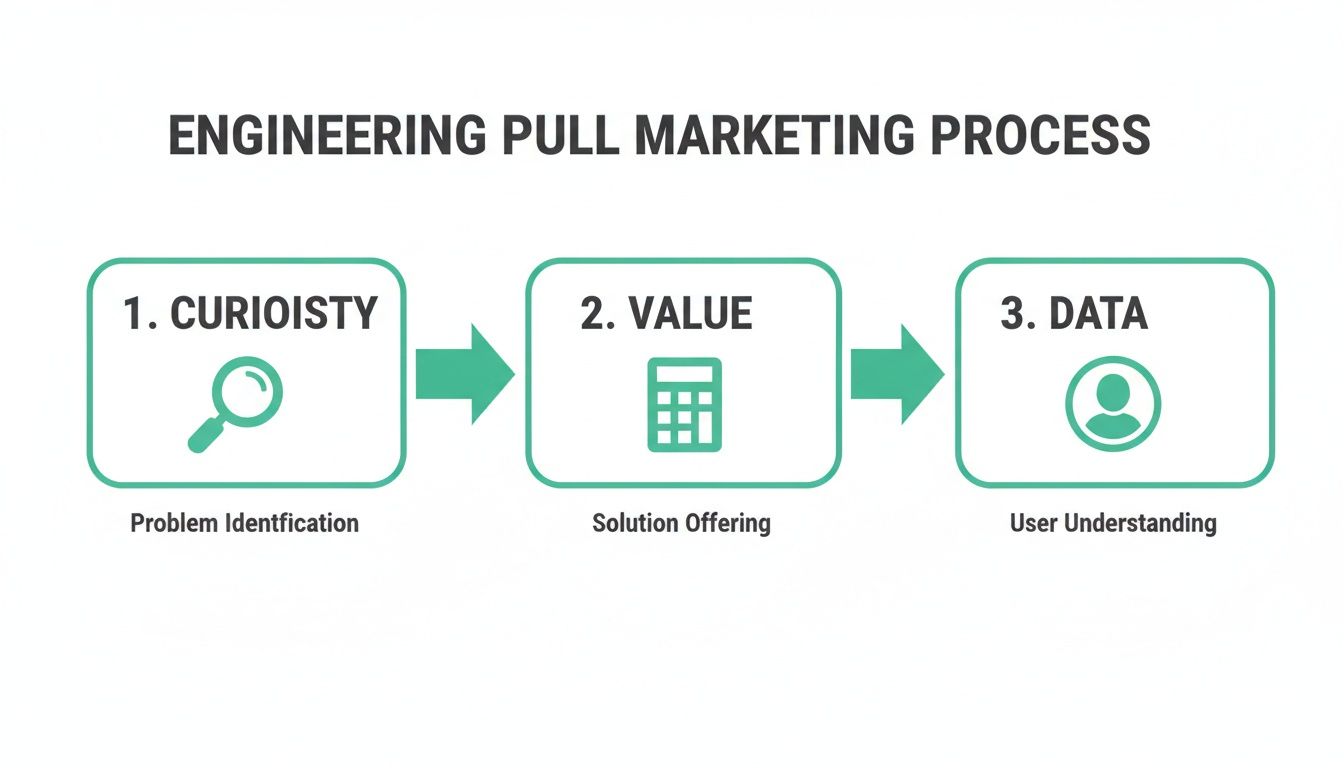
This simple process turns a passive browser into an active participant. It’s a fair, immediate trade of value for information.
Step 3: Build in Scoring and Segmentation
This is the part that turns your neat little tool into a lead qualification powerhouse. While the user is answering questions, you assign scores to their inputs behind the scenes. This lets you automatically segment them based on their needs, budget, or how ready they are to buy.
Let's go back to the 'Cybersecurity Risk Assessment' example:
- A user answers, "We don't have a firewall." They get +20 points (high risk, high intent).
- Another user answers, "We conduct quarterly security audits." They get -5 points (low risk, probably not a good fit right now).
By the end, you have a total score that instantly tells you how hot the lead is. It's a far more reliable—and scalable—system than having a human ask these same questions over and over. If you want to see this kind of logic in action, the principles behind an automated SEO audit tool are very similar.
Step 4: Create Personalised Results
The payoff for the user has to be immediate and genuinely insightful. A generic "Thanks, we'll be in touch" page is a massive wasted opportunity. You need to present the results in a dynamic, personalised report.
This report should clearly explain what their score or calculation means and—this is crucial—offer actionable next steps. For the 'Cloud Cost Calculator', the results page should break down the estimated monthly costs and have a clear button to "Discuss Your Quote with an Expert." For the risk assessment, it should show their risk level (e.g., "High Risk") and provide a few tailored recommendations based on their answers.
Step 5: Integrate It Into Your Funnel
Finally, your tool can't just be a lonely page on your website. It needs to be wired directly into your marketing and sales workflows. This is all about routing leads based on the data you just captured.
Using your scoring system, you can set up simple, automated rules:
- High-Scoring Leads (e.g., >80 points): Automatically create a new deal in your CRM, assign it to a sales rep, and send them an instant Slack notification for immediate follow-up.
- Medium-Scoring Leads (e.g., 40-79 points): Add them to a specialised email nurture sequence that sends content related to the specific problems they identified.
- Low-Scoring Leads (e.g., <40 points): Add them to your general email newsletter to keep your brand top-of-mind without burning sales resources.
This integration makes sure every single lead gets the right follow-up at the right time. It maximises your chances of conversion and proves just how powerful your new pull marketing engine really is.
Measuring The Success Of Your Pull Strategy

So, you've made the switch from push to pull. Great. But now your old metrics are useless. Ad impressions and email open rates just don't cut it anymore. They can't tell you if what you're doing is actually working.
To prove your pull strategy is more than just a buzzword, you need to track KPIs that show genuine buyer intent and, more importantly, a real impact on the pipeline.
This is about ditching the vanity metrics and focusing on hard data that gets your RevOps and leadership teams excited. You have to draw a straight line from your shiny new interactive tool to actual revenue. That’s how you build a rock-solid case for going all-in on pull marketing.
Core KPIs For Your Pull Marketing Engine
To really see what's going on, you only need to focus on a handful of metrics that truly matter. These KPIs show you the quality of the leads your tools are bringing in and how efficiently they're doing it.
Here’s what to obsess over:
- Conversion Rate (Visitor-to-Lead): This is the big one. It's the purest measure of your tool's effectiveness. What percentage of people who start your quiz or calculator actually finish it and become a lead? A well-built pull tool can hit conversion rates of 40-55%. Compare that to the sad 1-3% you get from a gated PDF. It’s a completely different league.
- Lead Quality Score: Your interactive tool shouldn’t just generate leads; it should qualify them on the fly. By tracking the average quality score, you can prove you’re not just attracting anyone—you're attracting the right people. This is the data that proves your pull strategy is pulling in high-intent prospects, not just tyre-kickers.
- Zero-Party Data Captured: Get specific about the intel you're gathering. Instead of a vague update, you can walk into a meeting and say, "This month, our assessment tool captured budget information from 75 qualified leads and project timelines from 60% of everyone who completed it." That's actionable data the sales team can use today.
Tying Pull Efforts To Revenue
Okay, lead quality is great, but the C-suite wants to see the money. The real mission is to prove ROI by connecting your pull marketing directly to closed deals. This means getting your attribution sorted out so you can track the entire customer journey.
The real power of a pull strategy lies in its ability to shorten the sales cycle. By delivering high-intent, well-educated leads who have already self-qualified, you empower your sales team to have more effective conversations and close deals faster.
This is where CRM integration is non-negotiable. You have to track a lead from the moment they interact with your tool all the way to a signed contract. Only then can you measure the two metrics that matter most to the business: Sales Cycle Length and Customer Lifetime Value (CLV).
When you can show that leads from your interactive tools close faster and are worth more over time, you’ve won.
And you can pour more fuel on the fire with smart re-engagement. Retargeting users who started your tool but didn't finish is a classic pull move. Research has shown that this tactic can significantly boost campaign effectiveness. It’s a clear sign of the massive ROI waiting for you when you successfully pull interested prospects back into your world. If you want to dive deeper, you can discover more insights about digital marketing effectiveness.
Real-World Examples Of High-Converting Pull Marketing
Theory is great, but seeing it work in the real world is what really matters. Watching a company nail the push-to-pull marketing transition gives you a blueprint. The best pull strategies don't just dangle content; they deliver real value with interactive tools that solve an immediate problem.
Let's break down a couple of B2B companies that built killer pull marketing assets. We'll look at the problem they faced, the tool they created, and the results they got.
Case Study 1: Unbounce’s Landing Page Analyser
The team at Unbounce, a top-tier landing page platform, knew their audience inside and out. They understood that marketers lie awake at night wondering if their landing pages are actually optimised to convert. Instead of writing yet another blog post on "best practices," they built the answer.
- The Problem: Marketers needed a fast, data-backed way to spot weaknesses in their landing pages without needing a developer or a data scientist on speed dial.
- The Pull Tool: They built the “Landing Page Analyser,” a dead-simple, free tool. You plug in a URL, and it spits back a detailed performance report, scoring everything from SEO and mobile-friendliness to the sentiment of your copy. Better yet, it gives you actionable advice.
- The Outcome: This thing became a lead-gen machine. It didn’t just tell marketers what to do; it showed them how to fix their own pages, right then and there. This was the perfect handshake, attracting high-intent users who were literally in the middle of trying to improve their conversion rates.
Case Study 2: HubSpot’s Website Grader
HubSpot is the undisputed master of pull marketing, and their famous "Website Grader" is the OG example. It first launched way back in 2007, and while it's been updated since, it’s still a monster lead magnet for them. Talk about staying power.
- The Problem: Small business owners knew their website needed to be better, but they were completely lost. Drowning in technical jargon, they had no clue where to even begin.
- The Pull Tool: The Website Grader lets anyone pop in their website URL and email to get a free, detailed performance score. It grades the site on essentials like speed, mobile optimisation, SEO, and security, then hands over a personalised checklist of what to fix.
- The Outcome: Millions have used the tool, funnelling a ridiculous volume of qualified leads straight to HubSpot. It’s a perfect match for their mission of helping businesses grow, positioning them as a helpful authority and smoothly guiding people toward their paid software.
These examples show how effective pull marketing often involves empowering your happy customers to share their experiences. To see how others are doing it, explore ways to leverage social proof to attract new customers.
The secret sauce here is the immediate, personal value exchange. A user gets an instant, useful answer to a nagging question, and the company gets a super-qualified lead who just told them exactly what they need help with.
You can see this global shift to pull marketing in other tech, too. Look at the explosion in Web Push Advertising, which pulls users in with notifications they actually agree to receive. It's a format that lines up with what people want: relevant messages that match their interests. This just proves the power of interactive funnels that attract leads by giving them something valuable first. Learn more about web advertising trends on Statista.
Bottom line? These case studies prove that building something genuinely useful is one of the most durable ways to generate high-quality leads.
Got Questions About Pull Marketing? Good.
As you start thinking about shifting away from push tactics, a few practical questions are bound to pop up. Let's tackle the most common ones head-on so you can make the move with confidence.
What’s an Interactive Pull Tool Going to Cost Me?
The price can swing wildly, but you don't need a massive budget to get in the game. You could spin something up on a no-code platform for a few hundred dollars a month, or you could commission a custom dev project that runs into the thousands.
But that’s the wrong way to look at it.
The key is to start with a minimum viable product (MVP)—think a simple calculator or a basic assessment. Prove the concept first. Focus on the value it gives your audience and the quality of the leads it spits out. An effective tool almost always delivers a faster and more sustainable return than just pouring more money into ads.
Can I Use Push and Pull Marketing Together?
Absolutely. In fact, you should. They work best as a team. The smartest strategies use targeted push tactics to get eyeballs on their high-value pull assets. For instance, you could run a super-specific paid ad campaign (that’s the push) pointing your ideal customers straight to your new interactive assessment tool (that’s the pull).
The goal isn't to kill off push marketing entirely. It's about rebalancing your efforts so your main engine for generating demand is built on creating value that naturally draws people in. Push tactics then become the amplifier, not the main event.
The most sophisticated strategies don't see push and pull as rivals but as complementary forces. Push creates the initial spark of awareness for your pull assets, which then do the heavy lifting of engaging and qualifying high-intent prospects.
How Long Until I Actually See Results from This?
This is where you need to shift your mindset. A push campaign gives you an instant hit of traffic, but the quality is often dodgy, and the effect vanishes the second you turn off the spend. Pull marketing is different; you're building a long-term asset.
An interactive tool can start bringing in qualified leads within days of launch. But its real power compounds over time. It starts pulling in organic traffic, builds your authority, and becomes a go-to resource in your space.
You can expect to see a real, measurable impact on your sales pipeline within the first 3-6 months. That's usually enough time to gather data, see what's working, and start optimising the tool and the automated follow-ups that go with it.